Tech News
This section serves as a general technology digest, pulling together the day's notable headlines. Expect a mix of software and AI developments, startup funding, product launches, and business news from across the industry, all in one place for a quick catch-up.
On any given day the lineup might pair a major AI announcement with a startup's funding round, a regulatory development, and a product launch worth knowing about. The goal is breadth: a cross-section of the industry rather than a deep dive into one corner of it.
A digest like this suits readers who want to stay informed without chasing dozens of sources. A few minutes of scanning covers the stories colleagues are likely to mention, making it a practical daily habit for anyone working in or around technology.
A new paper introduces a state-of-the-art method for line art vectorization that models strokes as Bézier curves and utilizes 2D Gaussian splatting for fast, differentiable rendering. By leveraging depth prediction and semantic feature extraction, the technique accurately captures artistic intent, supports video vectorization, and allows for seamless user corrections.
Comments
RISC-V: They should have known better
2026-08-15Developer Dmitry.GR has published a detailed critique explaining his strong distaste for the RISC-V instruction set architecture. The post outlines his specific technical grievances and argues that the creators of the open-standard design should have recognized and avoided its inherent flaws.
Comments

Cultivating solitude and deep focus is essential for fostering the creativity needed to generate groundbreaking ideas. The piece examines the habits of visionaries like filmmaker Ingmar Bergman and mathematician Alexander Grothendieck to illustrate this concept. Ultimately, it highlights how entering a specific mental state is crucial for driving true innovation and technological progress.
Comments
Hello, me. It's been a while
2026-08-14After a fourteen-year hiatus, a blogger is returning to their platform with a new update. Rather than focusing on technical topics, the post serves as a personal reflection on how both the world and the author have changed over the years.
Comments
Choose Boring Technology (2015)
2026-08-14The 2015 piece "Choose Boring Technology" advocates for selecting mature, well-understood tools for core infrastructure rather than chasing the latest industry hype. By relying on predictable systems, engineering teams can focus their innovation efforts on features that directly differentiate their product. This pragmatic approach ultimately reduces maintenance overhead and minimizes the risk of unexpected technical failures.
CommentsSpaghettifying DRAM
2026-08-14A new hardware research project demonstrates how attackers can use DRAM scrambling techniques to unlock restricted CPU features and bypass hardware security boundaries. By intentionally scrambling memory layouts, researchers have found a novel way to access previously hidden system capabilities across the entire processor. This discovery highlights potential new vulnerabilities in modern CPU memory management and underscores the need for robust hardware-level protections.
Comments
Understanding is the new bottleneck
2026-08-14As AI agents write code faster than humans can absorb it, comprehension has emerged as the primary bottleneck in modern software development. To maintain essential human understanding despite this rapid generation, developers are adopting new techniques like explainer docs, quizzes, and shared collaborative spaces.
CommentsNP-overrated
2026-08-14A recent tech analysis argues that NP technology is significantly overhyped and fails to deliver on the lofty promises made by industry proponents. The piece suggests that organizations should critically reevaluate their investments in NP solutions. Ultimately, the article highlights the practical limitations and hidden costs of NP that are frequently overlooked in today's market.
Comments
How Compaction Works in Pi
2026-08-14Large language models require compaction techniques to efficiently manage memory and maintain context during extended interactions. This article breaks down the mechanics of this process and explains how Pi specifically implements compaction to optimize performance and deliver a seamless user experience.
Comments
Ordinary abundance
2026-08-14This article details a walk through a modern apartment from the perspective of first-time inhabitants encountering its amenities. It highlights the contrast between ordinary technological abundance and the profound sense of wonder it evokes in those experiencing it for the first time.
CommentsA recent analysis of Chapter 1 of Principia Mathematica argues that the foundational logic and mathematics text remains highly relevant to modern computer science and theoretical research. The author provides detailed notes demonstrating how the century-old concepts are still remarkably insightful for today's technical readers.
Comments
The tech industry is celebrating the 45th anniversary of the original IBM PC and its iconic Model F/XT keyboard. This retrospective explores the history of these groundbreaking devices, tracing their origins and examining their enduring impact on modern personal computing.
Comments2026 Eclipse Webcams
2026-08-13Organizers are deploying a network of high-definition webcams to broadcast the upcoming 2026 solar eclipse to global audiences. These live streams will allow viewers worldwide to experience the celestial event in real-time from anywhere. The initiative highlights ongoing advancements in live streaming infrastructure and remote observation technology.
CommentsTim King, AmigaDOS developer, has died
2026-08-13Tim King, the pioneering developer behind AmigaDOS and founder of Perihelion Software, has passed away, prompting the tech community to reflect on his foundational contributions to the Amiga ecosystem and early ISP networking solutions. Many developers credit his innovative work, including the Helios operating system and command-line interfaces, as a crucial gateway to their careers in modern computing and Linux environments.
CommentsA researcher shared their PhD dissertation detailing a Bayesian parameter estimation method for locating radioactive sources in complex urban environments. The project was originally inspired by the historic Goiânia radioactive accident. The author recently engaged with an online community to discuss the probabilistic localization techniques developed in their work.
CommentsuBlock Origin is ending its ongoing battle to block advertisements on Facebook as the technical arms race between ad blockers and the platform intensifies. In response, users highlighted the severe privacy risks, malware threats, and system resource drains caused by modern advertising, arguing that the industry needs to shift toward subscription models to fully protect user data and device performance.
CommentsWhy tiny JPEGs look different in Chrome
2026-08-13Developer Guillaume Técher investigates the technical reasons behind Google Chrome's unique rendering of tiny JPEG images compared to other browsers, revealing how specific decoding and color management processes cause visual discrepancies. Understanding this browser-specific quirk helps web developers better anticipate rendering issues and optimize cross-browser image display.
Comments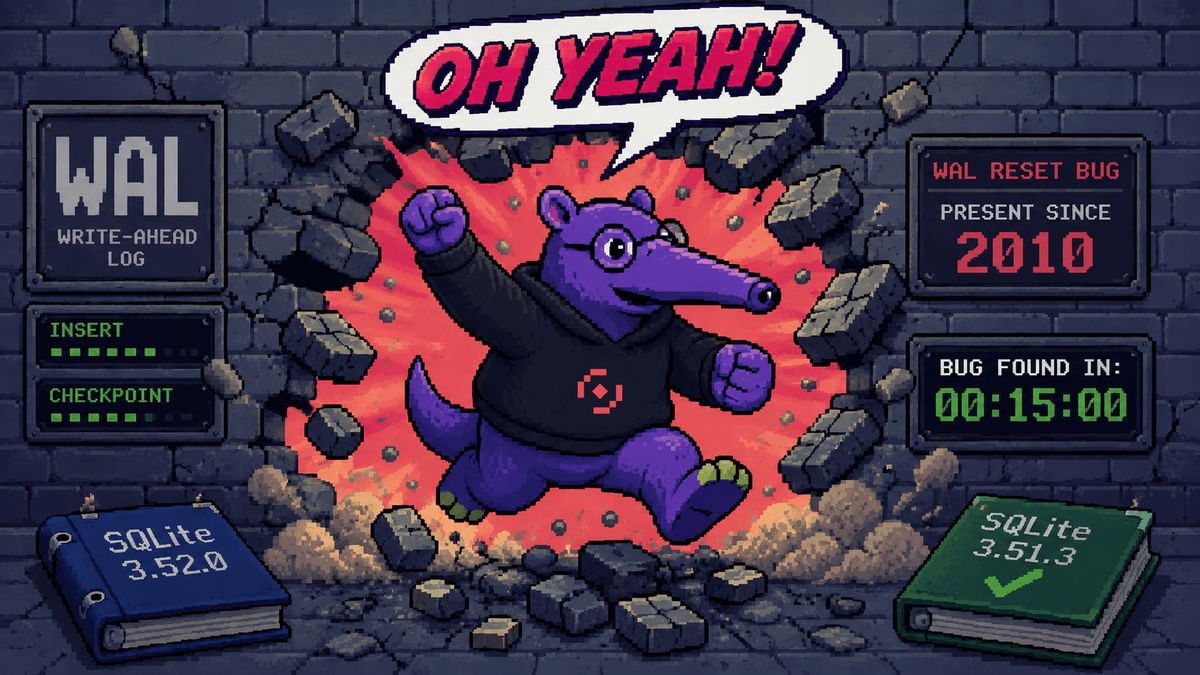
Breaking the WAL
2026-08-13This technical article details a developer's approach to optimizing database performance by rethinking or bypassing Write-Ahead Logging. The author shares the engineering insights behind this achievement, noting that the work was completed remotely from a lawn chair on the Sunshine Coast.
Comments
YC-backed startup Reflex is hiring for Growth and Go-To-Market roles to build its first formalized revenue engine from the ground up. Despite strong product-market signals including over a million apps built and significant GitHub traction, the company needs a technical leader to transition from founder-led sales to a scalable pipeline. The ideal candidate will combine software engineering experience with hands-on GTM strategy to convert open-source adoption into enterprise revenue.
Comments
A Tale of Dynamic Programming (2022)
2026-08-13This article explores the mechanics and widespread applications of dynamic programming, ranging from text parsing to robotics control. It provides a detailed breakdown of how the algorithm works, the specific computational problems it solves, and its core techniques.
Comments
Before the rise of digital job boards and professional networking platforms, newspaper classifieds served as the primary gateway to employment. This retrospective piece explores the traditional job hunting process, highlighting the stark contrast between nostalgic print-based methods and today's tech-driven recruitment landscape.
CommentsThe Human Is the Loop
2026-08-12In the article The Human Is the Loop, the author reflects on a recent multi-week break from artificial intelligence and the surprising impact it had on their daily habits. This digital detox revealed that their previous reliance on AI tools was neither productive nor healthy, highlighting the need for more mindful technology consumption.
Comments
Nvidia's Risky Business
2026-08-12Nvidia is helping its customers discover new ways to raise capital for artificial intelligence infrastructure. However, these new financing methods are significantly expanding the financial risks associated with the massive AI buildout.
CommentsThe London Underground has begun scanning passengers' faces, prompting widespread concern over the continuous erosion of personal anonymity and civil liberties in the UK. Readers view this move as part of a broader, inescapable trend of pervasive state and corporate surveillance that could be easily misused by future authorities. However, some acknowledge that similar facial recognition technologies, such as those used at supermarket self-checkouts, are primarily driven by corporate efforts to combat retail theft.
CommentsRecycle – Floppydisks
2026-08-11A specialized business is actively recycling old floppy disks while simultaneously purchasing new ones to maintain their inventory. This unique operation highlights the surprising ongoing demand for legacy storage media in the modern tech landscape.
Comments
Mark Twain famously lost his fortune investing in the Paige Compositor, a so-called mechanical miracle of an automatic typesetting machine that ultimately failed to deliver on its revolutionary promises. This historical cautionary tale from the first Machine Age highlights the recurring pitfalls of overhyped automation and the harsh realities of scaling early technological innovations. Modern tech leaders can draw valuable lessons from Twain's financial ruin as contemporary automation technologies continue to disrupt traditional industries.
CommentsMark Zuckerberg is criticizing closed AI competitors as Meta champions open-source models, a move the tech community credits with significantly accelerating the broader open-source AI revolution. Although readers debate whether Meta's release of Llama was a deliberate strategy or a reaction to a leak, there is consensus that it successfully built upon earlier foundational models to transform the industry.
CommentsRust SIMD on the GPU
2026-08-11Rust's portable SIMD is now available for GPU programming, enabling more efficient parallel processing on graphics hardware. The latest update details the technical implementation of this feature and highlights the new performance capabilities it unlocks for developers.
Comments
Humanising LLM Outputs Is Dumb
2026-08-11A recent tech commentary criticizes the growing trend of humanizing large language model outputs. The author notes a cultural shift on platforms like X and GitHub, where users increasingly prompt AI to simulate conditions like ADHD or use simplified technical English. Ultimately, the piece argues that these behavioral modifications are unnecessary and detract from the true utility of AI tools.
CommentsSecurity researchers have introduced a novel technique for exploiting x86 System Management Mode by utilizing an exceptionally long hardware interrupt. This method demonstrates how manipulating interrupt lengths can bypass traditional security boundaries to access highly privileged, low-level execution environments.
Comments