Mental Health Tech News Today
Digital tools are playing a growing role in mental health care. This section covers therapy and meditation apps, teletherapy services, AI-based support tools, and the research, funding, and regulatory questions surrounding technology built for psychological wellbeing.
Stories include clinical trials testing whether apps deliver measurable outcomes, teletherapy platforms expanding or facing scrutiny, AI chatbots being used for emotional support and the safety debates that follow, and employer and insurer moves to cover digital mental health benefits.
Demand for mental health care far exceeds the supply of clinicians, which is why technology's role here draws such intense interest. Therapists, health systems, investors, and people seeking help all follow this coverage, where questions of evidence, ethics, and access carry unusual weight.
Distributed Systems Classics (2017)
2026-09-15A curated resource titled Distributed Systems Classics highlights a selection of timeless and influential papers that have fundamentally shaped distributed systems research. This collection serves as an essential foundational reading guide for engineers and researchers looking to master the core concepts of distributed computing.
CommentsA developer showcased Bonsai, a custom voxel game engine built entirely from scratch over the past decade using signed distance fields and a proprietary metaprogramming language. After years of foundational work, the creator is now shifting focus to developing a closed-source environmental puzzle game that leverages the engine's impressive draw distances and terrain manipulation capabilities. The community highly praised the project's technical achievements and expressed strong interest in the upcoming game release.
Comments

Scientists studying individuals who lack the ability to visualize mental images are overturning long-held theories about human cognition. By examining the brains of these individuals, researchers are uncovering new insights that are fundamentally rewriting the science of imagination.
CommentsRecent archaeological insights highlight the crucial role of rope, twine, and thread as foundational Stone Age technologies. Although these early fiber innovations rarely survive in the physical record, they were essential for early tool-making and daily survival. This research sheds new light on how these overlooked ancient advancements fundamentally shaped human civilization.
Comments
Twenty-five Fields Medalists have signed an open letter warning of a severe misalignment between the objectives of AI companies and the mathematical community. The prominent mathematicians argue that current artificial intelligence development prioritizes corporate and governmental goals over genuine mathematical research and progress.
CommentsRecent research highlights how mind-altering substances historically influenced the rise of Andean civilization, while simultaneously sparking a modern renaissance in psychiatric treatments for mental illness. Although fading stigmas are opening new funding avenues for psychedelic research, experts note that translating these therapies into mainstream medicine remains complex. Specifically, researchers emphasize the need for rigorous clinical trials to address the unpredictable nature and potential safety risks of these powerful substances.
Comments
The Environmental Protection Agency plans to eliminate public review requirements for data center pollution, significantly limiting community input on local environmental impacts. These proposed rule changes would leave residents with much less influence over the pollution generated in their neighborhoods.
CommentsYuE2 is a new AI model that unifies symbolic and audio music generation to produce high-quality tracks. The system uses symbolic planning to convert user-provided lyrics and style prompts into an editable musical score. This process enables the generation of complete, fully produced songs featuring both vocals and instrumental accompaniment.
Comments
Cognitive scientist Douglas Hofstadter explores the role of analogy as the fundamental core of human cognition in a recent Presidential Lecture. The video presentation examines how analogical thinking shapes our understanding of the world through a variety of illustrative examples.
CommentsA recent study reveals that large language models develop emergent social biases and stratify fictional demographic groups during sequential hiring tasks by over-exploiting initial random successes rather than exploring alternatives. However, critics argue these biases are largely an artifact of the experimental prompts, which implicitly instruct the models to treat arbitrary demographic labels as meaningful selection criteria.
CommentsA new experimental syntax highlighter powered by WebGPU has been introduced to provide fast, language-agnostic code highlighting. Weighing in at just 27.5KB, this lightweight tool offers developers a highly efficient and versatile solution for working across multiple programming languages.
Comments
A new Harvard study led by researcher Matthew Nock demonstrates that smartphone technology can predict 75 percent of suicide attempts a week in advance. The team achieved this by using mobile devices to survey high-risk adults and adolescents in real time. This breakthrough highlights the potential of mobile technology to proactively identify and prevent mental health crises.
Comments
WeatherNext 3
2026-09-08WeatherNext 3 has been officially unveiled as the most advanced global weather AI model to date, representing a significant upgrade in artificial intelligence capabilities for worldwide meteorological forecasting. The new system is expected to deliver highly improved predictive accuracy and comprehensive environmental data analysis for users across the globe.
Comments
An international team of physicists has observed the effect of gravity on a falling quantum object for the first time. This breakthrough provides a crucial experimental connection between quantum physics and Einstein's theory of gravity.
Comments
A new arXiv paper investigates the universal geometric properties underlying machine learning embeddings to establish a unified mathematical framework. By analyzing how discrete data maps into continuous vector spaces, the researchers uncover fundamental structural patterns that apply across different data modalities. These geometric insights can be harnessed to optimize representation learning and improve the overall efficiency of diverse artificial intelligence models.
Comments
Every Novel Is Boring–Until It Isn't
2026-09-07A recent piece explores the immersive nature of reading, arguing that novels often feel tedious at first. However, books become completely engrossing once a reader experiences a mental switch that makes them unable to stop reading. This breakthrough typically develops organically during childhood, meaning those who missed it may never intuitively understand the compelling experience of novel reading.
CommentsExactTex is a gradually-typed superset of LaTeX that allows developers to add type annotations to existing source files without breaking them. This incremental approach provides checked references, safe renaming, and early error detection before the final PDF is even generated.
CommentsA recent article argues that viewing large language models merely as next-token predictors is a flawed mental model that obscures their true capabilities. While technically accurate at the architectural level, this reductionist perspective fails to capture the complex reasoning and emergent behaviors these systems actually exhibit. Experts urge the tech community to adopt broader conceptual frameworks to better understand and develop future artificial intelligence technologies.
CommentsAsk HN: Who is hiring? (September 2026)
2026-09-02The September 2026 Hacker News hiring thread highlights strong industry demand for engineers specializing in AI infrastructure, government automation, and autonomous robotics. Startups like Statecraft and Source are building AI workforces for the US government and local-first data layers for AI agents, while companies such as Greenzie and Monumental are deploying autonomous machines for commercial mowing and construction. Meanwhile, edge cloud provider Fastly is expanding its global engineering teams with a continued focus on open standards and WebAssembly technologies.
Comments
The infamously simulation-heavy colony builder Dwarf Fortress is receiving a major Myth and Magic update in late 2026. This new content will feature a dynamically generated sorcery system tailored specifically to each player's unique world.
CommentsThis article explores how Network Address Translation, initially introduced as a temporary fix for IPv4 address exhaustion, fundamentally altered the original peer-to-peer architecture of the internet. By breaking the foundational end-to-end connection model, NAT inadvertently paved the way for the modern era of internet centralization and reliance on centralized servers.
Comments
No country for mediocre mathematicians
2026-09-01In a reflective essay, a struggling geometer critiques the exaggerated claims surrounding artificial intelligence's capabilities in mathematical reasoning and warns against the deceptive narratives pushed by tech companies. The piece explores how the growing pressure to adopt these overhyped AI tools is impacting average mathematicians and fundamentally reshaping the academic landscape.
CommentsAn open-source developer has released an experimental Linux DRM/KMS driver for the Silicon Motion SM750 GPU. The new driver enables advanced display capabilities such as HDMI output, custom RGB565 dithering, DMA, and software-scaled ultrawide modes. This release highlights the power of community-driven development in bringing modern features to specialized hardware.
CommentsStartup Anti-Patterns
2026-08-31This article explores the concept of startup anti-patterns, defined as seemingly effective strategies that ultimately cause more harm than good. Building on Simeon Simeonov's foundational 2013 insights, the piece highlights the critical importance of recognizing and avoiding these detrimental practices within the startup ecosystem.
CommentsBug Blindness
2026-08-30A recent discussion on bug blindness examines why both software developers and everyday users frequently overlook technical flaws in digital products. Developers tend to miss bugs because their deep system knowledge creates shared blind spots and unconscious workarounds, whereas regular users lack a foundational mental model and simply adapt to erratic software behavior as if it were normal.
Comments
Nancy Grace Roman Space Telescope
2026-08-30The Nancy Grace Roman Space Telescope is an upcoming mission designed to resolve critical questions regarding dark energy, exoplanets, and astrophysics. This advanced observatory will provide scientists with unprecedented data to deepen our fundamental understanding of the universe.
Comments
Glacier Mice
2026-08-30The article discusses glacier mice, a phenomenon observed on glaciers in diverse locations worldwide, including Alaska, Iceland, and formerly Venezuela. Reader discussions highlight the global distribution of this phenomenon while also touching on broader environmental changes, such as the retreat of Venezuelan ice and the formation of a new glacier at Mount St. Helens. Additionally, the community expresses appreciation for the article's link to a Wikipedia entry, which sparked broader conversations about tracking front-page Wikipedia posts.
Comments
EVE Online moves to Python 3
2026-08-30The developers of EVE Online have successfully completed a massive technical migration, moving its 2.4 million lines of code to Python 3. This monumental update modernizes the software's underlying architecture and ensures long-term stability for the platform.
Comments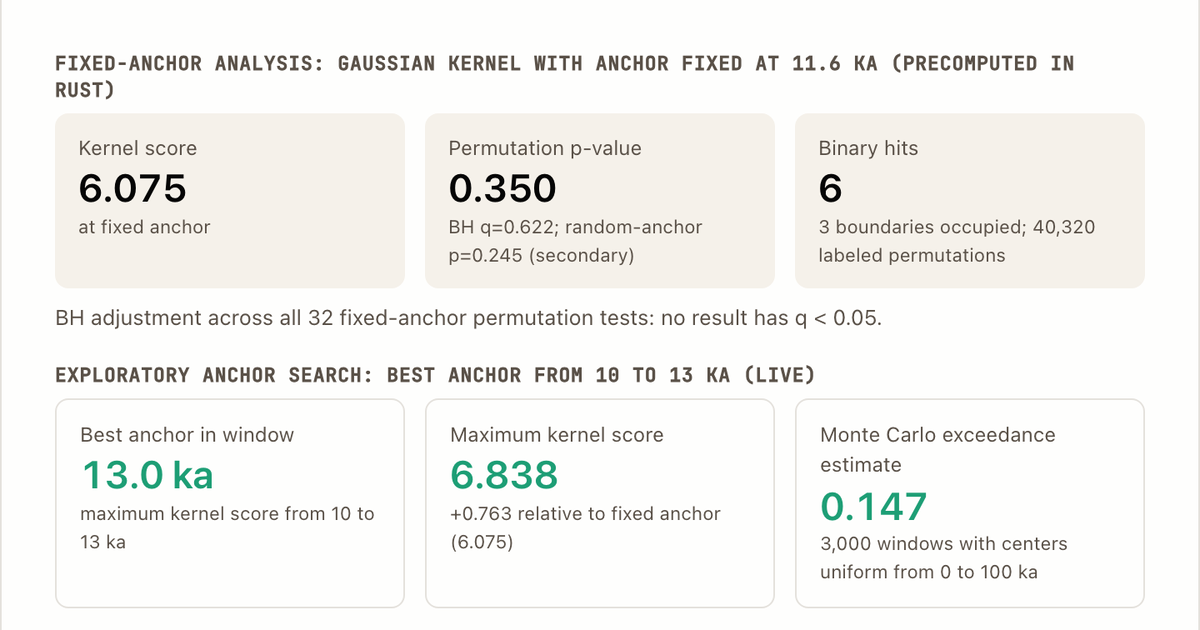
Researchers are applying statistical modeling to determine if the mythological reign lengths of the antediluvian kings in the Sumerian King List align with historical paleoclimate events. By comparing these ancient timelines against environmental data, the study investigates whether the legendary rulers' tenures correspond to actual climate shifts better than random chance.
Comments
A developer has introduced Lemmalog, a Datalog engine that improves LLM agent memory by treating knowledge as program analysis state with support for provenance, retractions, and incremental evaluation. The system's performance was recently validated through benchmarking on the LongMemEval and LoCoMo datasets.
Comments