HR Tech News
Software now touches every part of how companies hire, pay, and manage people. This section gathers news on HR platforms, recruiting tools, payroll and benefits systems, and the growing use of AI in workforce decisions. It is aimed at HR professionals, founders, and anyone curious about the technology behind modern workplaces.
Coverage commonly includes funding and product news from HR software vendors, AI screening and interviewing tools entering the hiring process, and platforms that manage global payroll and contractor compliance. Studies and rules addressing bias in automated hiring decisions come up regularly as the technology spreads.
The stakes are high because these systems influence who gets hired, how much people are paid, and how performance is judged. HR leaders selecting software, vendors watching competitors, and employees who want to understand the systems evaluating them all have reasons to follow this space.
A Python Interpreter Written in Python
2026-04-17A new project called Byterun implements a Python interpreter written entirely in Python, sparking community debate over the architectural differences between self-hosting interpreters and compilers. While critics note that circular interpreters can create inefficient runtime chains compared to self-hosted compilers, supporters highlight the project's value for educational experimentation and demystifying language execution. The ensuing discussion also delves into the technical nuances of bootstrapping and the exact definitions of interpreters, JIT compilers, and PyPy's compiled RPython subset.
Introducing: ShaderPad
2026-04-17Programmer and designer Riley J. Shaw has introduced ShaderPad, a new project reflecting his commitment to repair and craft in technology. This release aligns with his broader mission to build transparent, remixable tools that promote a sustainable and accessible future.
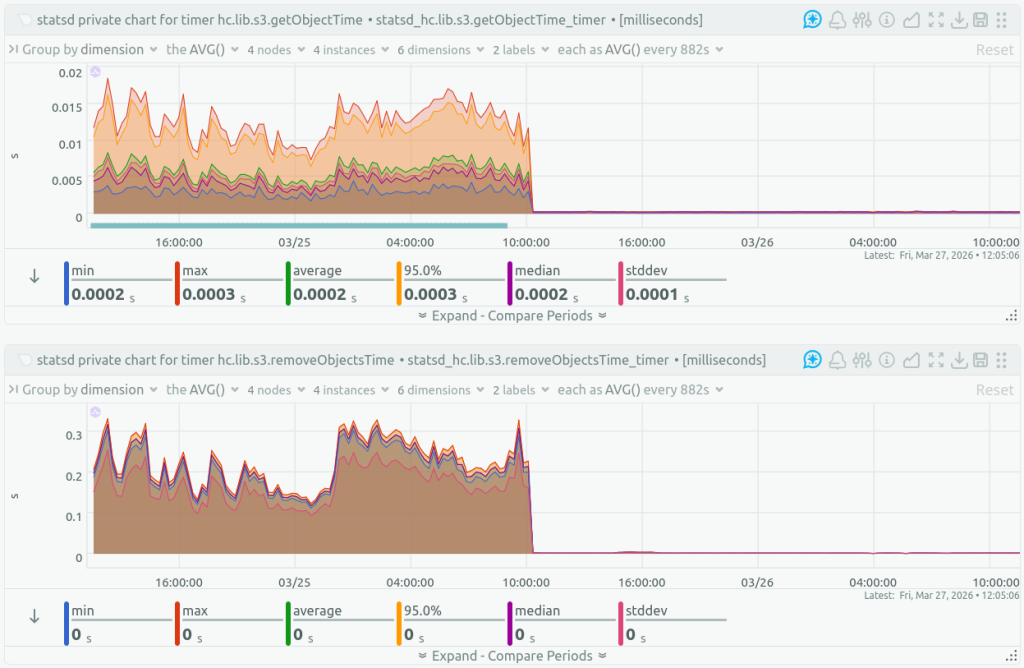
Healthchecks.io now uses self-hosted object storage
2026-04-17Healthchecks.io has migrated to a self-hosted, S3-compatible object storage system to manage larger request payloads from its monitoring endpoints. The service now routes HTTP POST bodies up to 100kB to this new infrastructure, while continuing to store smaller payloads directly in its PostgreSQL database.
FIM – Linux framebuffer image viewer
2026-04-17FIM is a Linux framebuffer image viewer that enables users to display images and perform file recovery directly from the terminal without a graphical desktop. Community discussions highlight similar framebuffer tools for media playback, though users note that modern lightweight Wayland setups often provide better hardware performance than traditional framebuffer devices. Despite these performance trade-offs, developers continue to embrace these minimalist environments for their extreme system simplicity and potential security benefits in an AI-driven landscape.
ReBot-DevArm: open-source Robotic Arm
2026-04-17Seeed-Projects has launched ReBot-DevArm, an open-source robotic arm designed specifically for developers. The project is hosted on GitHub, where the community is invited to contribute to its ongoing development.
The GNU libc atanh is correctly rounded
2026-04-17The GNU C Library has updated its math functions to achieve fully correct rounding for the double-precision atanh operation, moving beyond the traditional 1 ULP accuracy target. This ongoing initiative provides strict numerical guarantees that are essential for designing reliable algorithms in critical fields like aerospace and medical simulations. While these highly accurate implementations perform well on modern CPUs, developers still face significant optimization challenges when adapting them for GPU and NPU architectures.
Experiment with ICEYE Open Data
2026-04-17ICEYE has made a wealth of open data resources available for researchers and developers to experiment with. This initiative allows the tech community to freely explore and research the full potential of Synthetic Aperture Radar technology.

Human Accelerated Region 1
2026-04-17Discussions surrounding Human Accelerated Region 1 highlight its critical activity in early brain development and spark broader scientific interest in mapping temporal gene activation patterns across the entire human life cycle. While researchers are developing advanced single-cell atlases to track these complex genetic expressions, creating a comprehensive visualization remains challenging due to ethical constraints and vast natural variability between individuals.

I built a 3D printing business and ran it for 8 months
2026-04-17A 3D printing enthusiast shares a firsthand business report detailing the practical realities of running their own 3D printing company for eight months. The account provides valuable insights for tech entrepreneurs regarding the operational challenges and financial viability of turning a hobby into a commercial enterprise.

Everything we like is a psyop?
2026-04-17This article examines the growing concern that TikTok's algorithmic feed is artificially shaping modern culture and consumer trends. It questions whether popular digital phenomena are the result of organic interest or manipulative growth hacking. Ultimately, the piece urges society to establish clear boundaries between legitimate marketing practices and inauthentic algorithmic manipulation.

Connie Converse was a folk-music genius. Then she vanished
2026-04-17Connie Converse was a pioneering folk musician who created forward-thinking songs in the 1950s. She remained largely unknown during her lifetime and mysteriously disappeared at the age of 50. Today, a new re-release of her recordings has finally earned her widespread recognition as a trailblazer.

Discourse Is Not Going Closed Source
2026-04-17Following Cal.com's recent decision to close its source code over AI concerns, Discourse has announced it will remain open source. The platform's creators reaffirmed their commitment to transparent development after 13 years of building the software in public.

Claude Opus 4.7
2026-04-16The latest model, Claude Opus 4.7, is now generally available. This update delivers notable improvements over Opus 4.6, specifically enhancing performance in advanced software engineering and tackling the most difficult tasks.

Qwen3.6-35B-A3B: Agentic coding power, now open to all
2026-04-16Qwen has released Qwen3.6-35B-A3B, an openly available model designed to deliver advanced agentic coding capabilities to developers. This release enhances the broader Qwen Studio ecosystem, which offers a comprehensive suite of multimodal features including image and video understanding, document processing, and web search integration.

Codex for almost everything
2026-04-16Positioning itself as a tool for almost everything, the updated Codex app for macOS and Windows introduces advanced features like computer use, in-app browsing, image generation, memory, and plugins. These comprehensive enhancements are designed to significantly accelerate and streamline developer workflows.
IPv6 traffic crosses the 50% mark
2026-04-16Despite IPv6 traffic crossing the 50% mark, technical discussions highlight ongoing debates regarding its practical benefits and the internet's persistent reliance on NAT. While widespread adoption is recognized as crucial to combat IPv4 address exhaustion, many practitioners still prefer IPv4 for local network setups due to its cleaner architecture and the complexities of bridging the two protocols.
The future of everything is lies, I guess: Where do we go from here?
2026-04-16Readers are debating the societal impact of large language models, warning that automating core cognitive skills could eliminate traditional pathways for upward mobility. While some fear this shift will cause society to regress into pre-technological hierarchies reliant on physical strength and discriminatory practices like primogeniture, others argue we are not doomed to repeat the past. Ultimately, the discussion highlights deep anxieties about how advanced artificial intelligence might reshape human values, fairness, and social equity in the future.

Cloudflare's AI Platform: an inference layer designed for agents
2026-04-16Cloudflare is upgrading its AI Gateway into a unified inference layer designed to streamline development for AI agents. The platform update allows developers to access models from over 14 providers while introducing new Workers AI bindings and an expanded catalog of multimodal models.
The paper computer
2026-04-16A developer created a paper computer prototype for a Gemini hackathon that uses a projector, camera, and AI agent to transform ordinary paper into an interactive display. The screen-free device allows children to engage with digital media through physical objects, offering a tactile alternative to traditional tablets. The creator and online community are now seeking support to refine the minimal prototype into a fully functional product.

Android CLI: Build Android apps 3x faster using any agent
2026-04-16A newly introduced Android CLI tool allows developers to build applications three times faster by integrating seamlessly with any automated agent. This enhancement to the Android developer tools ecosystem streamlines workflows and significantly boosts overall productivity.