HR Tech News Today
HR departments run on software, and this section keeps track of it. Coverage includes recruiting platforms, payroll and benefits systems, employee engagement tools, and the rapid arrival of AI in hiring and people management. Funding rounds and product news from the HR tech market round out the picture.
Recent story patterns include AI screening and interviewing tools facing both adoption and scrutiny, payroll providers expanding into global employment services, consolidation among HR software vendors, and new regulations governing automated hiring decisions. Workforce analytics and skills-mapping products are a growing theme.
The systems covered here quietly decide who gets interviewed, how people are paid, and how performance is judged, affecting nearly every worker. HR leaders, talent acquisition teams, and vendors in the space follow this news to choose tools wisely and stay ahead of compliance changes.
A developer built a static HTTP web server entirely from scratch using aarch64 assembly language, embracing the extreme challenge of bare-metal programming. The project serves as both a deep dive into low-level architecture and a humorous personal quest for meaning through code.
CommentsAI meeting note-takers are raising legal concerns by potentially voiding attorney-client privilege and turning casual conversations into discoverable permanent records. Beyond these privacy risks, users report that the tools frequently produce highly inaccurate transcripts when handling poor audio quality. This inaccuracy stems from the underlying language models confidently hallucinating missed words based on context rather than acknowledging audio uncertainties.
Comments
dBase: 1979-2026
2026-05-11The pioneering database software dBase has officially ended its nearly five-decade run, with its final newsgroup servers going offline in November 2025. The platform's ultimate demise was hastened by years of product neglect, complex vendor litigation, and the rapid rise of artificial intelligence.
Comments
The rise and fall of snake oil
2026-05-11This article explores the 19th-century evolution of snake oil, tracing its transformation from a traditional folk remedy to a mass-produced industrial medicine. The piece details how the product eventually lost its public credibility and became universally recognized as a fraudulent medical scam.
CommentsReaders are revisiting a highly praised 2010 blog post by Matt Might that demonstrates how to implement a programming language in just seven lines of code. Commenters celebrate the tutorial for demystifying computer science and argue that such foundational concepts should be taught to everyone, not just computer science majors. The discussion also compares this elegant Lisp-based implementation to other minimal language projects, highlighting the enduring beauty of concise code.
CommentsHardware Attestation as Monopoly Enabler
2026-05-10Apple and Google are increasingly pushing third-party services to adopt hardware-based attestation to verify device integrity across mobile apps and the web through similar frameworks like their respective Integrity APIs. This coordinated expansion of hardware verification standards could ultimately serve as a powerful tool to further entrench the tech giants' market dominance.
CommentsLocal AI needs to be the norm
2026-05-10The tech industry is increasingly advocating for a shift toward running artificial intelligence directly on user devices rather than relying on remote cloud servers. By establishing local AI models as the standard default, the ecosystem can significantly improve system performance and enhance overall data privacy for end users.
CommentsAn early cloud advocate who championed foundational AWS services like S3 and EC2 during the platform's infancy recently returned to the ecosystem. Upon re-engaging with the cloud giant, the author was quickly reminded of the exact frustrations that initially drove them to leave.
Comments
Incident Report: CVE-2024-YIKES
2026-05-10A new security vulnerability designated as CVE-2024-YIKES has been reported, with the incident details ominously characterized as a series of unfortunate events. Cybersecurity teams are currently investigating the exact nature of the flaw, though specific technical details remain undisclosed. Users are advised to monitor official channels for further updates and potential patch deployments.
Comments
Implementing API idempotency extends far beyond simply adding an HTTP header or performing a basic key lookup. A new article breaks down the complex failure cases that challenge real-world systems, such as mismatched requests, concurrent retries, and partial successes. It offers practical guidance for developers on handling critical edge cases like downstream uncertainty, response replay, and duplicate message handling.
Comments
A sophisticated cyber campaign is exploiting a malicious Obsidian note-taking app plugin to deploy a new remote access trojan named PHANTOMPULSE. The malware is specifically targeting victims operating within the finance and cryptocurrency sectors.
CommentsTask Paralysis and AI
2026-05-10Individuals with ADHD are increasingly leveraging artificial intelligence tools to overcome task paralysis and manage overwhelming cognitive loads. By using AI to break down complex projects into actionable steps, neurodivergent users can bypass the executive dysfunction that typically halts their progress. This emerging trend highlights the growing potential of AI to serve as a personalized assistive technology for focus and productivity.
CommentsA new macOS application called Drawers helps developers maintain focus by creating dedicated virtual spaces, customized docks, and isolated window environments for each of their projects. The app allows users to assign granular resources like specific chat channels to these workspaces to prevent context switching and distractions. The tech community has responded enthusiastically to the project, with users eager to beta test and suggesting future enhancements like project-specific app theming and crash isolation.
Comments
The One Dollar Counterfeiter
2026-05-10The article explores the case of Mister 880, a petty criminal who spent a decade passing fake one-dollar bills and inadvertently triggered the most expensive investigation in Secret Service history. Reader discussions question the disproportionate government manhunt for such a low-stakes crime while explaining the agency's original mandate to protect the nation's currency. The thread also highlights humorous personal anecdotes involving foolish fraud attempts and pedantic debates over the exact definition of counterfeiting.
CommentsThe Casio S100X Japanese Lacquer Edition is a premium calculator captivating tech enthusiasts with its exquisite typography and meticulous aesthetic details. Readers note that the device's stunning design could easily trigger a deep passion for collecting high-end calculators, sparking broader discussions about the allure of premium tech accessories and the slippery slope of design obsession.
Comments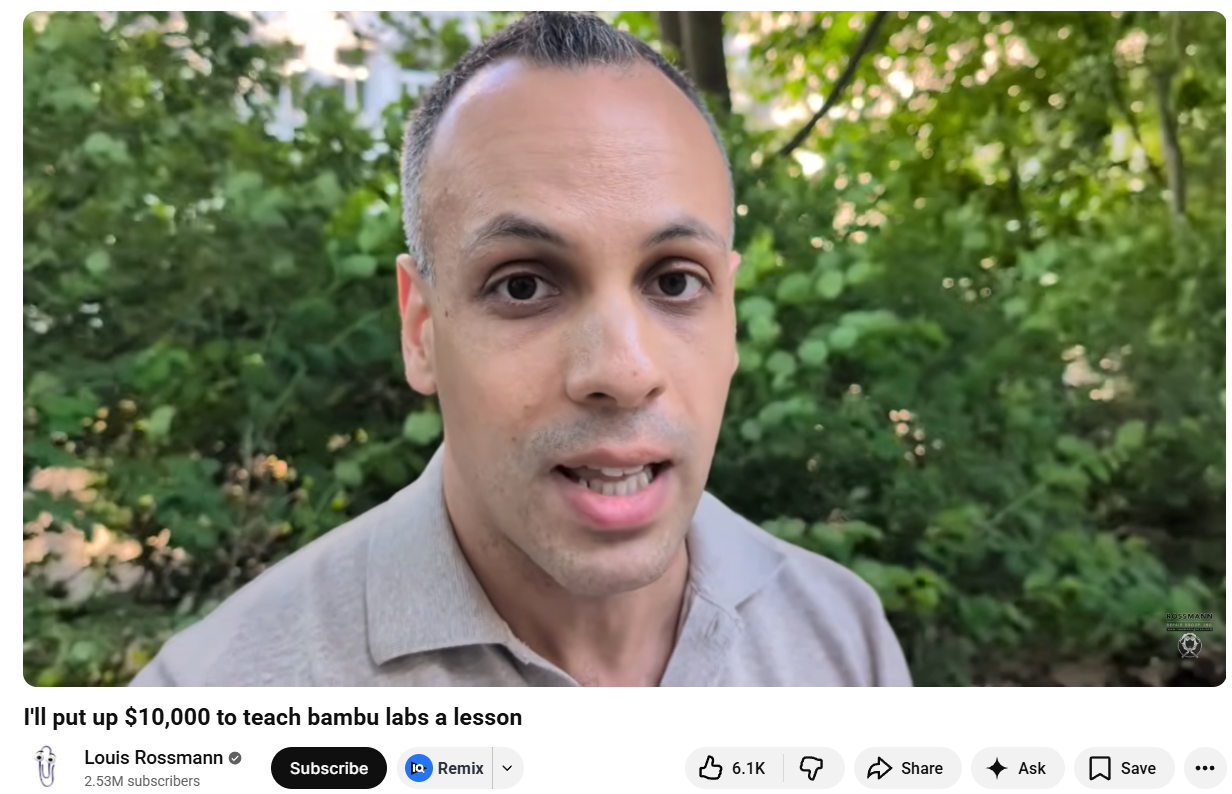
Right-to-repair advocate Louis Rossmann has offered to cover the legal fees of an OrcaSlicer developer facing legal threats amidst an escalating controversy with Bambu Labs. This financial support aims to protect open-source contributors as tensions rise between the 3D printing community and hardware manufacturers over software licensing disputes.
CommentsA developer has shared a MacOS web server written exclusively in ARM64 assembly language. The project, showcased on Hacker News, was built as a personal challenge to explore extreme low-level system programming. The resulting application operates natively without relying on higher-level abstractions or traditional software frameworks.
CommentsThe first element of the Fehmarnbelt Tunnel has been successfully immersed, marking a major milestone for the ambitious engineering project. Once fully completed, the underwater structure will set a new global record as the longest immersed tunnel in the world.
Comments
Traces Of Humanity
2026-05-10After a seven-year hiatus, the lead developer of the privacy-focused operating system Qubes OS has resurfaced with a new blog. The creator of the highly secure system, which they began developing in 2009, announced their return to reconnect with the tech community.
CommentsThink Linear Algebra (2023)
2026-05-10Allen Downey has released Think Linear Algebra, the latest addition to his widely praised series of freely available computer science textbooks. Readers commend his ongoing commitment to open educational resources and discuss the book's unique computational pedagogy. By using Jupyter notebooks to teach matrix multiplication and eigenvectors before basic vector arithmetic, the text takes a deliberate top-down approach to help students reach practical applications faster.
Comments
Challenging the traditional academic model of the linear theory of innovation, Thomas Dullien suggests that technological progress is often driven by empirical observation rather than prior theoretical understanding. In this iterative approach, innovators first discover what works in practice and only later develop the frameworks to fully comprehend why it works.
CommentsRecent findings suggest that an involuntary decrease in walking speed may be an early indicator of hearing loss rather than musculoskeletal decline. Although reader discussions largely focused on the physical discomfort and philosophical benefits of different walking paces, the underlying study highlights an unexpected physiological connection between auditory health and mobility.
Comments
Maryland citizens are facing a $2 billion power grid upgrade bill driven by the massive energy demands of out-of-state AI data centers. This situation has sparked controversy, raising questions about why local consumers are bearing the cost instead of the AI hyperscalers that require the expanded infrastructure.
Comments
Space Cadet Pinball on Linux
2026-05-10Stephen Brennan has reverse-engineered and ported the classic Windows 3D Pinball Space Cadet game to run natively on Linux. This project allows Linux users to play the nostalgic title directly without relying on emulators or compatibility layers.
CommentsA recent article explores a new method for preventing Man-in-the-Middle attacks during the initial SSH connection to newly provisioned cloud servers, aiming to solve the cryptographic bootstrapping problem. Readers debate the technique's novelty, arguing that existing built-in solutions like SSHFP DNS records and private key-certs already address the issue despite requiring complex configurations like DNSSEC. The broader discussion highlights the ongoing industry challenge of securely establishing initial trust and distributing keys in cloud environments without relying on bespoke workarounds.
Comments
What's a mathematician to do? (2010)
2026-05-10A 2010 post on the MathOverflow forum features an undergraduate student seeking unconventional academic guidance from the online community. The user apologized for deviating from standard mathematics topics, highlighting the platform's history of helping students navigate similar career inquiries.
CommentsThe locals don't know
2026-05-10The author shares a contrarian approach to tourism by advising visitors to avoid mimicking the habits of local residents. The core message suggests that locals may not actually know the best attractions or activities for tourists. Therefore, travelers should forge their own unique itineraries rather than simply following the crowd.
Comments
Gemini API File Search is now multimodal
2026-05-10Google has updated the Gemini API File Search tool to support multimodal data processing. This enhancement makes it significantly easier for developers to build efficient file retrieval systems. These new capabilities allow applications to seamlessly handle and search through diverse file types.
Comments
The first chapter of a new six-part history of Visual Basic has been published on the EvilGeniusLabs website, highlighting lesser-known aspects of the programming language's origins. This installment explores Microsoft's early BASIC dynasty, the acquisition of a California developer to front the project, and Bill Gates' strategic marketing pitch prior to the software's release.
Comments
Eight More '8-Bit Era' Microprocessors
2026-05-10This latest tech retrospective highlights eight additional microprocessors from the 8-bit era that were omitted from a previous hardware roundup. The piece explores the history and technical specifications of these overlooked chips to further celebrate the innovations of early computing.
Comments