AI Tech News Past 24 Hours
AI news moves quickly, and this section helps you keep pace. It surfaces recent stories on model launches, research advances, funding and partnerships among AI companies, enterprise adoption, and the regulatory and societal questions the technology keeps raising.
In any given stretch the stories might include a lab releasing a new model or capability, a multibillion-dollar infrastructure deal, a startup emerging with notable backing, fresh benchmark results, or a government moving on AI rules. Product integrations and safety debates round out the mix.
Few fields make a daily check worthwhile the way AI does, because capabilities and competitive positions genuinely change week to week. Engineers choosing tools, leaders setting strategy, and readers trying to understand the technology's trajectory all benefit from a recent-first view.
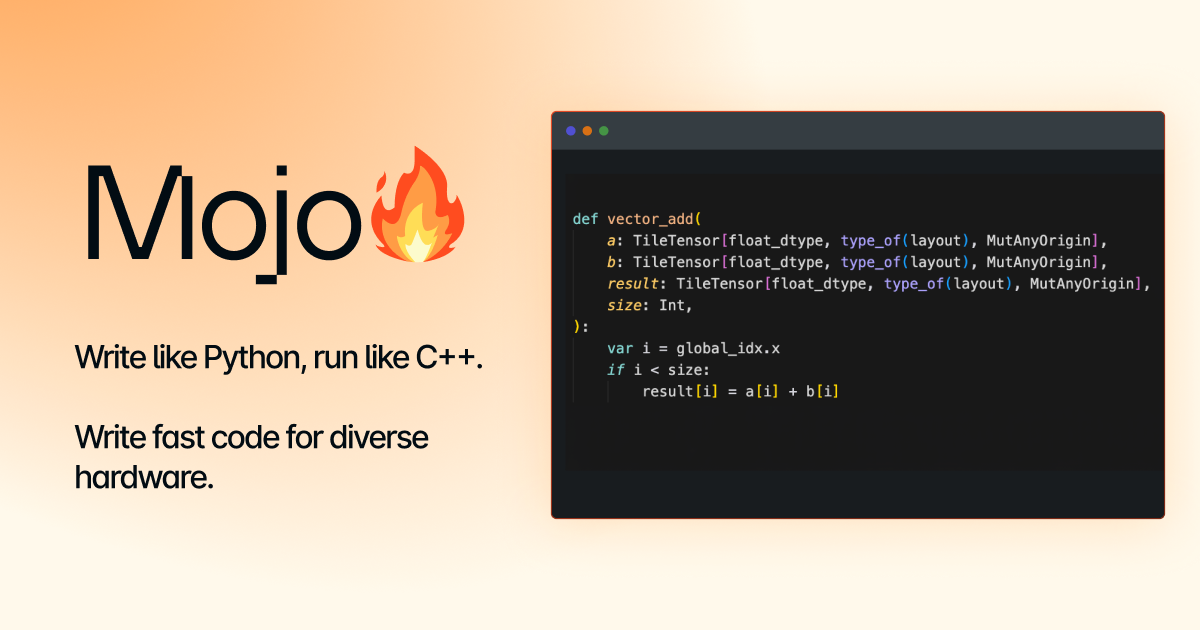
Mojo 1.0 Beta
2026-05-08The Mojo programming language has officially reached its 1.0 Beta milestone, advancing its mission to combine Python's ease of use with C-level performance for artificial intelligence. This release delivers increased stability and new capabilities to help developers efficiently build and deploy complex machine learning models. The update signals that Mojo is rapidly maturing and preparing for widespread adoption in the competitive AI landscape.

US Government releases first batch of UAP documents and videos
2026-05-08The US government has released its first batch of official documents and videos regarding Unidentified Anomalous Phenomena, commonly known as UAP. This declassification effort supports the military's ongoing mission to investigate unidentified aerial incidents and ensure national security. The newly disclosed materials provide researchers and the public with unprecedented access to data surrounding these unexplained events.
You gave me a u32. I gave you root. (io_uring ZCRX freelist LPE)
2026-05-08A local privilege escalation vulnerability has been identified in the Linux kernel's io_uring subsystem, specifically within the zero-copy receive freelist. The flaw involves a mishandling of a 32-bit unsigned integer that allows an attacker to exploit the memory management structure and gain full root access to the system.

Hardening Firefox with Claude Mythos Preview
2026-05-08New details have emerged on how the Claude Mythos Preview is being used to harden the Firefox browser through advanced agentic harnesses. These AI agents can now autonomously identify and reproduce genuine software bugs while successfully dismissing false positives.

Plasticity and language in the anaesthetized human hippocampus
2026-05-08Researchers at Baylor College of Medicine discovered that the human hippocampus remains capable of sophisticated language processing even when a patient is fully unconscious under anesthesia. This finding highlights the remarkable plasticity of the brain and suggests that the anesthetized mind retains complex cognitive functions previously thought to be lost.

Nonprofit hospitals spend billions on consultants with no clear effect
2026-05-08A new study reveals that nonprofit hospitals spent $7.8 billion on consulting services over the past decade. Despite this massive financial investment, researchers found no significant improvements in hospital finances, staffing, daily operations, or patient care outcomes. The findings suggest that this heavy reliance on external consultants has yielded little to no measurable value for the healthcare system.
PC Engine CPU
2026-05-08Community discussions highlight the historically underrated processing power of the PC Engine's 8-bit CPU, noting that its high clock speed and specialized memory transfer capabilities enabled impressive arcade ports that rivaled 16-bit competitors. Enthusiasts also explored the theoretical performance limits of modern 6502-based architectures while praising the system's compact physical design and highly optimized console adaptations of classic Capcom games.
GNU IFUNC is the real culprit behind CVE-2024-3094
2026-05-08Recent analysis of the XZ Utils backdoor suggests that the GNU IFUNC mechanism was the fundamental enabler of the exploit, transforming a standard supply chain compromise into a deeply hidden system-level threat. By weaponizing indirect function resolution, the attacker successfully concealed malicious code within the liblzma library, highlighting a critical need to reevaluate the security implications of IFUNC features in modern build systems.
Ask HN: We just had an actual UUID v4 collision...
2026-05-08Prompted by a developer's report of an unexpected UUIDv4 collision, the tech community emphasizes that such failures are surprisingly common due to flawed or poorly understood entropy sources. To prevent this, experts advise against using UUIDv4 in high-reliability systems, recommending instead the aggregation of multiple diverse, non-deterministic data points. Furthermore, modern cryptographic techniques can extract true randomness from these imperfect sources by blending them into a single, unpredictable seed.
ClojureScript Gets Async/Await
2026-05-08ClojureScript has officially integrated native async/await support into its core compiler, overcoming previous community skepticism regarding implementation complexity. Spearheaded by developer borkdude after prototyping the feature in his Squint project, this update provides a modern alternative to the older core.async library. The release has also sparked broader discussions within the community regarding asynchronous error handling and the shift toward minimal JavaScript frontends using server-sent events.
All means are fair except solving the problem
2026-05-08Reader discussions surrounding a recent article highlight ongoing developer frustrations with command-line tools that mishandle stdout, stderr, and exit codes instead of simply fixing underlying problems. While POSIX conventions dictate keeping stdout clean for data piping and using stderr for logging, many tools and brittle system environments continue to violate these expectations. Participants emphasize that adhering to these foundational CLI practices is essential for reliable scripting and automation.

The Disappearance of the Public Bench
2026-05-08The disappearance of public benches and the trend of making remaining ones uninviting highlights a broader societal debate regarding who belongs in urban public spaces. By eliminating these resting spots, cities are losing crucial communal infrastructure and marginalizing the populations that rely on them.

A polynomial autoencoder beats PCA on transformer embeddings
2026-05-08Researchers have developed a closed-form polynomial autoencoder that achieves fourfold compression of transformer embeddings while outperforming traditional PCA. By pairing a PCA encoder with a quadratic Ridge decoder, the method delivers superior accuracy without requiring neural networks or iterative training.

The map that keeps Burning Man honest
2026-05-07Burning Man utilizes mapping technology to measure and track its environmental footprint, transforming its Leave No Trace principle into a data-driven commitment. The resulting maps are made publicly available to ensure the event maintains strict accountability for its cleanup standards.
Dirty Frag: Universal Linux LPE
2026-05-07A newly disclosed Universal Linux Local Privilege Escalation vulnerability named Dirty Frag shares the same root cause in the kernel IPsec module as the previously discovered Copy Fail bug. The overlapping flaws have sparked a debate among security researchers about whether relying heavily on AI for vulnerability discovery hinders the manual code exploration needed to uncover related issues.

Agents need control flow, not more prompts
2026-05-07Reliable AI agents handling complex tasks require deterministic control flow encoded directly in software rather than relying on increasingly elaborate prompt chains. Shifting the focus from complex prompting to structured software design will ultimately result in more stable and predictable agent performance.

AI slop is killing online communities
2026-05-07Online community managers are struggling to combat the influx of AI-generated content and deceptive bot accounts, which adds significant administrative and financial burdens. To protect their platforms, moderators are deploying rigorous verification methods, including third-party AI detection tools and manual authorship checks. Despite these measures, many community leaders fear that the endless battle against automated AI slop may eventually become unsustainable.
DeepSeek 4 Flash local inference engine for Metal
2026-05-07A new local inference engine for DeepSeek 4 Flash and PRO models has been introduced via the antirez/ds4 project. It allows users to run these advanced AI models locally across multiple hardware platforms by providing native support for Apple's Metal, Nvidia's CUDA, and AMD's ROCm.

AlphaEvolve: Gemini-powered coding agent scaling impact across fields
2026-05-07AlphaEvolve is a coding agent powered by Gemini that optimizes algorithms to accelerate scientific progress across multiple disciplines. By applying this technology to complex challenges in genomics, quantum physics, and global infrastructure, the tool aims to solve critical real-world problems at scale.

Natural Language Autoencoders: Turning Claude's Thoughts into Text
2026-05-07Researchers have introduced Natural Language Autoencoders to translate the internal numerical computations of AI models like Claude into human-readable text. This breakthrough allows developers to observe the system's underlying thought processes, offering greater transparency into how these models generate their final word-based outputs.