Massive AI models run on tiny hardware.
LLMs reward expertise

Recent reader discussions highlight that large language models heavily favor users with existing technical expertise, as novices often lack the specific vocabulary needed to prompt effective code generation. While programming experts can build simple applications in a single prompt, non-technical users frequently get trapped in endless brainstorming loops or struggle with basic developer interfaces. This reveals a significant gap between the promised democratization of software creation and the reality of using AI tools without foundational domain knowledge.
CommentsAmazonian civilization had estimated 3M people in 3% of forest area
Recent estimates reveal that the ancient Amazonian civilization supported a population of approximately three million people. This large population was concentrated within just three percent of the total Amazon forest area.
CommentsTen advances in mathematics and theoretical computer science
Although the original article highlights ten recent advances in mathematics and theoretical computer science, reader discussions primarily focus on the societal and political implications of exponential technological growth driven by large language models. Commenters express concern over the unprecedented ability of AI to scalably manipulate individuals through highly personalized, real-time conversational engagement. The debate also explores how these computational breakthroughs will impact experimental fields like biology and potentially exacerbate political polarization through advanced digital manipulation.
CommentsShow HN: Run an 80B Qwen in 4.3 GB of RAM on a Mac, and a 35B on an iPhone
A new open-source project called Swiftlet enables users to run massive large language models on Apple devices with remarkably low memory requirements. The tool successfully demonstrates running an 80-billion parameter Qwen model using just 4.3 GB of RAM on a Mac, alongside a 35-billion parameter model on an iPhone. This advancement significantly lowers the hardware barrier for running powerful local AI inference on everyday consumer devices.
CommentsDevtools must be open source

The article argues that developer tools must remain open source to support the industry's rapid shift toward highly personalized software. Open-source devtools provide the necessary flexibility and community-driven innovation required to build these customized applications. Ultimately, keeping these tools open is essential for developers to thrive in this new era of personalized technology.
CommentsAsk HN: Who is hiring? (August 2026)
Hacker News has launched the August 2026 edition of its monthly "Who is hiring?" thread, providing a centralized platform for tech professionals to discover new job opportunities. Companies and recruiters are actively posting open roles across various engineering and technology disciplines. Job seekers can browse the community-driven discussion to explore these openings and connect directly with potential employers.
CommentsThat time when I failed the Microsoft interview

A developer reflects on their unsuccessful 2015 Microsoft internship interview, which they pursued during their computer science degree after gaining confidence from open-source contributions. The author recalls targeting the tech giant specifically because of its impressive work on TypeScript and the open-source rewrite of the C# compiler.
CommentsAsk HN: Who wants to be hired? (August 2026)
The August 2026 Hacker News hiring thread features numerous software engineers and infrastructure specialists showcasing their technical expertise to potential employers. Candidates highlight extensive backgrounds in AI infrastructure, distributed computing, and full-stack development using languages like Rust, Go, and TypeScript. While the majority of applicants are seeking remote opportunities, several remain open to relocation for the right roles.
CommentsWindows XP 2002 for the Itanium: Unbridled rage
Reader discussions reflect on the ill-fated Windows XP 64-bit Edition for Intel's Itanium architecture, noting it was uniquely built on the Windows Server 2003 kernel. Commenters attribute the platform's failure to reach the consumer market to high costs, poor x86 emulation, and the rapid rise of AMD's competing x86-64 architecture. Ultimately, Itanium was relegated to niche high-performance computing roles before Microsoft completely dropped operating system support after Windows Server 2008 R2.
CommentsSmaller, faster, safer: running Kimi and GLM at scale

Serving frontier AI models like Kimi and GLM at scale requires overcoming significant GPU memory constraints through techniques like KV cache quantization and weight compression. These optimizations enable faster and cheaper deployment, while newly implemented integrity checks ensure safer model serving.
CommentsMiniMax H3 Day-0 Support in ComfyUI: Open Weights, Native Audio, and 2K Video

ComfyUI now features day-zero support for MiniMax H3, an open-weights omni-modal video model that generates 2K resolution video with native stereo audio. Thanks to significant optimizations, this powerful model can be run locally on accessible consumer hardware like a 3060.
CommentsPrevent cognitive debt by manually retyping LLM-generated code
Developers are debating the practice of manually retyping LLM-generated code to prevent cognitive debt and ensure a deeper understanding of the software being built. While some argue this meticulous workflow negates AI efficiency gains and reduces engineers to mindless typists, others find value in using AI as a collaborative design tool rather than a direct code generator. The discussion reflects broader industry anxieties about the future of software engineering, with many anticipating a shift away from manual coding toward high-level visual architecture.
Comments200 Milliseconds
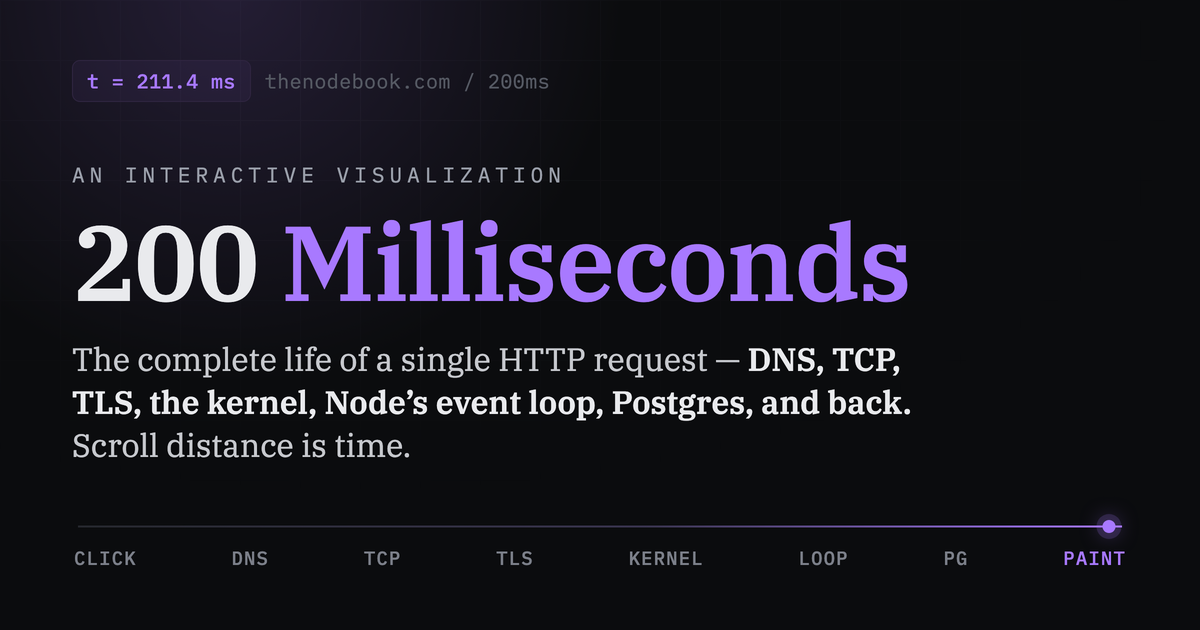
A new interactive visualization traces the entire lifecycle of a single HTTP request during the 200 milliseconds after a user presses Enter. The project maps the data journey through DNS, TCP, TLS, the Linux kernel, Node's event loop, and Postgres back to the user interface, using scroll distance to represent elapsed time.
CommentsCelebrating 45 Years of Kermit with the First New C-Kermit Release in 15 Years
Celebrating its 45th anniversary, the legendary file transfer program Kermit has been updated with its first new C-Kermit release in 15 years. Historically celebrated for its unmatched portability across countless incompatible legacy systems and its reliability on poor dial-up connections, the project's extensive source code archive continues to serve as a vital repository for preserving obscure, defunct computing platforms.
CommentsThere Will Come Soft Rains (1950) [pdf]
Readers are revisiting Ray Bradbury's classic short stories There Will Come Soft Rains and The Pedestrian to discuss their enduring relevance to modern technological isolation and existential threats. The conversation compares the tales of post-human automation and nuclear annihilation to contemporary anxieties like global warming and upcoming science fiction films. Ultimately, the discussion highlights a debate over Bradbury's literary style and a growing cultural fatigue with dystopian narratives.
CommentsAndy Pavlo joins ClickHouse to establish ClickHouse Labs
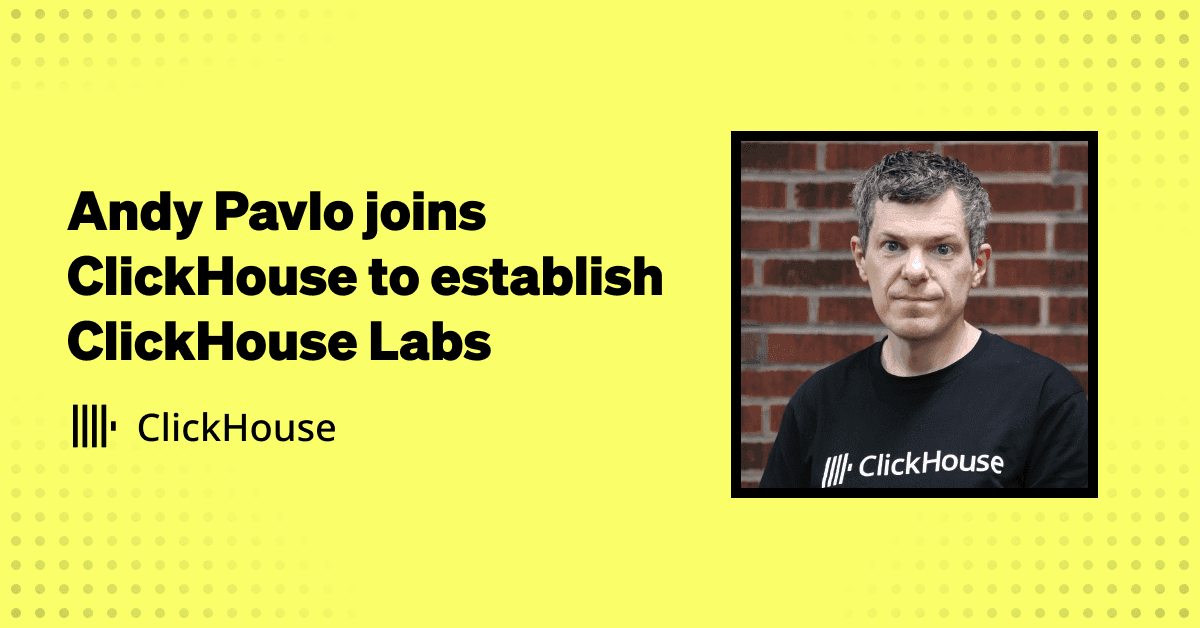
Andy Pavlo has joined ClickHouse, Inc. to establish and lead a new research team named ClickHouse Labs. This strategic addition will help expand the company's research capabilities and drive future technological innovation.
CommentsThey Forgot What Happened Last Time: Hacking the Windows 365 Link [video]
![They Forgot What Happened Last Time: Hacking the Windows 365 Link [video]](https://static.media.ccc.de/media/events/emf/2026/9301-f90bd1d9-c8e7-5c82-9ca3-045545a0f063_preview.jpg)
Security researchers have successfully hacked the Windows 365 Link, a locked-down thin client designed exclusively to connect to Microsoft's Cloud PC. By breaking out of its restricted Windows 11 environment, they demonstrated that the device can be repurposed, echoing past failures in Microsoft's attempts to lock down its hardware.
CommentsReplacing the Kobo Libra H2O Battery
A recent guide on replacing the Kobo Libra H2O battery has prompted readers to discuss the broader repairability of Kobo e-readers using commodity parts. Although newer models use soldered eMMC storage, users emphasize that screens, SD cards, and standard lithium-ion batteries can be easily swapped to extend the devices' lifespans. The community strongly encourages repairing aging e-readers with generic components instead of purchasing replacements.
CommentsZX Spectrum System Tour: Text Mode

Moving beyond the hardware control offered by BASIC, this installment of the ZX Spectrum System Tour dives into machine language to explore the system's text mode. The article begins a multi-part deep dive into the lower-level capabilities of the classic computer's text rendering.
CommentsHow Hollywood stopped making movies in Hollywood

Driven by favorable tax incentives and lower production costs, the film industry has increasingly relocated its major productions away from Los Angeles to other global locations. This economic shift has fundamentally altered the traditional Hollywood landscape, leaving audiences largely unaware of the geographic substitutions on screen.
CommentsLaunch HN: Hoplite (YC S26) – Effortlessly deploy cloud coding agents

Y Combinator S26 startup Hoplite has launched to offer developers an effortless way to deploy cloud coding agents. The platform focuses on streamlining the setup process while delivering a highly intuitive and enjoyable user experience.
CommentsBonsai: Janestreet's UI Library
Jane Street has introduced Bonsai, a new UI library designed for building dynamic web applications using the OCaml programming language and the Js_of_ocaml compiler. This release provides a robust framework that allows developers to seamlessly translate their front-end code into JavaScript for efficient browser execution.
CommentsDecades-old fish sauce at abandoned factory in Canada finally being removed
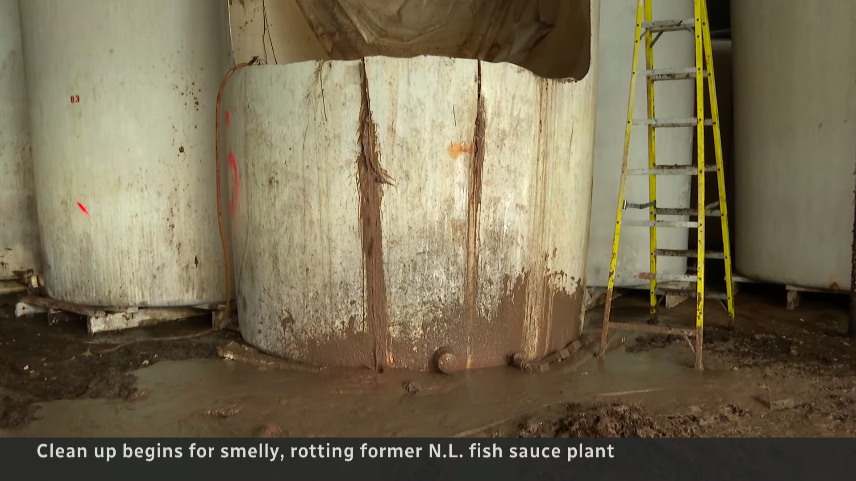
After sitting in 110 large vats at an abandoned Canadian factory for over two decades, a massive batch of fermenting fish sauce is finally being removed. The decomposing capelin and salt mixture has produced a foul stench that has plagued the local community for years. Cleanup crews are now working to safely empty the vats and eliminate the lingering odor.
CommentsTwenty Years of Pandoc
The open-source universal document converter Pandoc is celebrating a major milestone by marking its twentieth anniversary. Over the past two decades, the software has become an indispensable utility for developers and academics to seamlessly convert between various markup formats. This occasion highlights the enduring impact and continued relevance of the foundational project within the modern tech ecosystem.
CommentsAirLLM 70B inference with single 4GB GPU
A new open-source project called AirLLM enables the inference of 70B parameter large language models using only a single 4GB GPU. This dramatic reduction in hardware requirements makes running advanced AI models highly accessible to users with limited computing resources. Developers can view the code and contribute to the project's ongoing development on GitHub.
CommentsMassively Parallel Postgres Backups
PlanetScale has significantly reduced backup times for petabyte-scale sharded Postgres databases by completing the process in just a few hours. The company achieves this efficiency by leveraging massively parallel infrastructure, object storage, and WAL replay technologies to handle the massive data loads.
CommentsThe Dunning-Kruger effect may just be a data artefact (2020)

The widely cited Dunning-Kruger effect, often used to explain why incompetent individuals overestimate their abilities, may not be a genuine psychological phenomenon. Instead, recent analysis suggests this popular cognitive bias is actually just a statistical data artefact.
CommentsBattle of the Beams
Discussions surrounding the article Battle of the Beams highlight the pivotal World War II advancements in radar and radio navigation pioneered by scientists like Reginald Victor Jones. These historic breakthroughs in electronic countermeasures and beam navigation not only altered the course of the war but also established the technological foundation for modern aviation, GPS, and contemporary radar systems.
CommentsKisakCOD – Open-source reimplementation of Call of Duty 4 Multiplayer
A new open-source project named KisakCOD aims to reimplement the multiplayer experience of the classic game Call of Duty 4. Hosted by SwagSoftware on GitHub, the initiative is actively seeking community contributions to help develop and refine the codebase.
CommentsMore German than many Germans

An individual originally sought a European internship to improve their post-graduation job prospects, but the experience ultimately transformed their life. This unexpected journey led to such deep cultural assimilation that the author now considers themselves more German than many native citizens.
Comments