EU Approves Chat Control, John Deere Repairs, AI Advances
Show HN: Getting GLM 5.2 running on my slow computer
A developer has introduced Colibri, a lightweight engine that runs the massive 744-billion parameter GLM-5.2 AI model on consumer machines with just 25GB of RAM. Written in pure C with zero dependencies, the project achieves this feat by streaming model experts directly from disk instead of loading them entirely into memory. This innovation dramatically lowers the hardware requirements for running immensely large language models locally.
CommentsShow HN: 18 Words

A new daily word puzzle game called 18 Words has launched on Hacker News. The fast-paced browser game requires users to unscramble words against a timer, challenging players to correctly solve all 18 daily prompts.
CommentsEU Parliament greenlights Chat Control 1.0
The European Parliament has greenlit the Chat Control 1.0 proposal following a controversial procedural maneuver by the European Commission to force a second-reading vote on previously defeated legislation. Critics argue this tactic undermines democratic norms by requiring an absolute majority to reject the measure, effectively bypassing prior parliamentary rejections to push through the surveillance initiative.
CommentsJohn Deere owners will get the right to repair equipment under FTC settlement
The Federal Trade Commission and state attorneys general have secured a right to repair settlement with John Deere. Under the agreement, equipment owners will be allowed to independently fix their own machines without facing corporate restrictions.
CommentsGPT-5.6
OpenAI's developer guide for GPT-5.6 highlights improvements in intent understanding and image processing, emphasizing that shorter prompts now yield better performance and lower costs. Readers discuss the model's reduced default verbosity and compare its output to competitors like Claude, while also debating the technical distinction between context curation and actual machine learning.
CommentsPostgres rewritten in Rust, now passing 100% of the Postgres regression tests
A new project called pgrust has successfully rewritten the PostgreSQL database engine using the Rust programming language. The Rust-based implementation recently achieved a major milestone by passing 100% of the standard Postgres regression tests. This accomplishment demonstrates the viability of leveraging Rust for complex, enterprise-grade database systems.
CommentsHy3
Simon Willison's recent blog post evaluates AI image generation using his pelican test, prompting readers to question the benchmark's validity as models may be over-trained on his specific SVG examples. The community discussion also reflects on the broader impact of AI on software development, with some developers expressing a preference for hand-coding despite the industry's rapid shifts. Additionally, readers debated the current capabilities of local models, noting that Gemma4 and Deepseek 4 currently outperform GPT-OSS for coding tasks.
CommentsThe glass backbone: Why the Army's logistics will break in the next war

The United States Army's logistics network, optimized over the last two decades for uncontested environments and static bases, has become a critical vulnerability in modern warfare. As the military shifts toward large-scale multidomain combat, this fragile and efficiency-driven supply chain must now prioritize resilience to avoid collapsing in future conflicts.
CommentsNo leap second will be introduced at the end of December 2026
A leap second will not be introduced at the end of December 2026 because Earth's rotational speed remains highly unpredictable due to environmental factors, geological activity, and human water management. Because maintaining highly accurate predictive models for satellites and other systems is increasingly difficult, the international community has agreed to completely phase out the practice of adding leap seconds by 2035.
CommentsMuse Spark 1.1

Meta is facing criticism over the benchmark performance of its new Muse Spark 1.1 model after it was discovered that evaluations exceeded strict CPU and RAM limits. Critics argue that overriding these resource constraints on the Terminal-bench-2.1 leaderboard invalidates the results and fails to measure real-world agent behavior. However, some defenders downplay the controversy, suggesting that relaxing limits is common industry practice aimed at preventing task timeouts rather than outright cheating.
CommentsInterview with Mitchell Hashimoto about Ghostty and Zig
A recent interview with Mitchell Hashimoto explores his pragmatic engineering decisions behind the Ghostty terminal emulator and his use of the Zig programming language. The ensuing discussion highlights his stance on open-source forking, where he argues that maintaining a custom fork to remove unwanted features is comparable in effort to maintaining a feature flag. This perspective sparked broader debates among readers regarding the synchronization burdens of forks, the open source project as a product mentality, and the potential for AI to automate downstream customizations.
CommentsA road to Lisp: Why Lisp

This article explores the enduring appeal and unique advantages of the Lisp programming language for modern software development. It highlights Lisp's powerful macro system, code-as-data philosophy, and significant historical influence on contemporary functional programming paradigms. Ultimately, the piece serves as a comprehensive guide for developers looking to understand why Lisp remains a highly respected and influential language today.
CommentsMeta reuses old RAM in new servers with custom bridge chip

Meta has deployed a custom bridge chip across millions of new servers to reuse older RAM modules. This hardware innovation reduces the number of machines needed for specific inference workloads by 25%.
CommentsA possible future for Damn Interesting

The popular long-form storytelling website Damn Interesting has unveiled a strategic plan to ensure its long-term survival and financial sustainability. The announcement outlines the platform's future direction, though the author self-deprecatingly notes the post contains an awkward abundance of moist metaphors.
CommentsGirls just wanna have fast MPMC queues with bounded waiting
A recent article proposing a fast MPMC queue was corrected to clarify that its bounded waiting structure is not actually wait-free, sparking community discussions about the inherent trade-offs in concurrent queue design. Participants emphasized that developers must carefully weigh compromises between bounded memory, global FIFO ordering, and non-blocking behavior to select the data structure that best fits their specific system requirements.
CommentsSpider venom kills varroa mites without harming honeybees
Researchers have discovered that spider venom can selectively eliminate devastating varroa mites without harming honeybees. Beekeepers currently rely on complex and labor-intensive management techniques, such as brood cycle interruption and chemical deterrents, to combat these destructive pests. This new targeted approach could offer a highly effective and streamlined solution for protecting honeybee colonies.
CommentsBuried Apple feature turns an iPhone into the perfect kids' dumb phone

An overlooked Apple accessibility feature originally designed for users with cognitive disabilities can transform a standard iPhone into the perfect dumb phone for children. Despite offering excellent parental control capabilities, this underutilized setup remains largely unknown to the general public.
CommentsWhy American ambulance rides are so expensive

A recent analysis explores the botched economics driving the exorbitant cost of ambulance rides in the United States. The article details how fragmented emergency care, opaque billing practices, and a complex mix of private and public providers create a system where patients bear the brunt of the financial burden. Ultimately, these systemic flaws in healthcare pricing make emergency medical transport uniquely and persistently expensive for American consumers.
CommentsShow HN: Yamanote.fun – A complete soundscape for Tokyo's Yamanote line

Yamanote.fun is a new web experience that captures the complete audio soundscape of riding Tokyo's Yamanote train line. The project seamlessly weaves together every station's unique departure melodies, chimes, announcements, and ambient noise into one continuous journey around the city.
CommentsNew Sweden: the US's long-lost 'secret' colony

New Sweden was the smallest, least-populated, and shortest-lived colony in early American history, remaining largely obscure in modern times. Despite its brief existence, this overlooked settlement played a crucial role in shaping the birth of the United States 250 years ago.
CommentsTLS certificates for internal services done right

This article outlines best practices for managing TLS certificates for internal services, helping teams avoid the common pitfalls of self-signing. Implementing these proper certificate strategies ensures secure internal communications and eliminates frustrating TLS connection errors.
CommentsLaunch HN: Context.dev (YC S26) – API to get structured data from any website
Y Combinator S26 startup Context.dev has launched a new web scraping API specifically designed to help AI agents extract structured data from the internet. The platform allows developers to scrape individual URLs into clean markdown or HTML, crawl entire websites, and process the information using a single REST API. This tool aims to streamline data collection and formatting for developers building AI-driven applications.
CommentsOpinionated and easy Pi.dev configuration

Developers can now streamline their workflow by using a new one-command setup for the Pi platform that provides a fully curated coding agent experience. This opinionated package comes pre-loaded with over 60 skills, 67 themes, sub-agents, and a Claude Code CLI provider to deliver a comprehensive, ready-to-use solution right out of the box.
CommentsWhy developers are ditching GitHub for Codeberg and self-hosting alternatives
Developers are reportedly migrating to platforms like Codeberg and self-hosting alternatives amid frustrations over GitHub's declining service quality and frequent outages. Although skeptics question the true scale of this shift and warn of herd behavior, usage data indicates a clear upward trend in interest for these alternative platforms.
CommentsSimPolitics: America’s quest to solve politics with computers

For more than six decades, the public has been promised that computers will revolutionize and solve complex national and international political issues. SimPolitics explores the history of this technological optimism and its frequent collision with the messy realities of actual governance.
CommentsCargo-nextest: 3x faster than cargo test, per-test isolation, first-class CI

Cargo-nextest is a next-generation test runner for Rust designed to execute tests up to three times faster than the standard cargo test command. It improves development workflows by introducing per-test isolation and offering first-class support for continuous integration environments.
CommentsUnicode's transliteration rules are Turing-complete
It has been demonstrated that Unicode's UTS #35 transliteration rules are Turing-complete, with one developer successfully computing the Collatz conjecture using just three rewrite rules in the stock ICU library. While discovering Turing-complete weird machines in mundane data formats is a fascinating computer science novelty, the practical security risk is minimal because the rules are strictly controlled by software vendors and engines enforce rewrite limits. Furthermore, given the immense complexity required to support thousands of global languages and contextual text transformations, developers note that it would actually be more surprising if Unicode's formatting options were not Turing-complete.
CommentsMy thoughts on the Bun Rust rewrite
A blog post by Zig founder Andrew Kelley regarding Bun's decision to rewrite its codebase in Rust has sparked a fierce debate over professional conduct in open-source leadership. While some readers defend Kelley's post as authentic personal expression, critics argue that relying on gossip and hostile language reflects poorly on his leadership and could ultimately damage the Zig community.
CommentsGLM 5.2 is nearly as accurate as a human book keeper

The open-weights AI model GLM 5.2 demonstrated near-human bookkeeping accuracy by processing a real quarterly UK VAT return. It completed 59 transactions in 68 minutes for just $2.73, yielding a final calculation within 7 pence of the human-prepared result.
CommentsBenchmarking coding agents on Databricks' multi-million line codebase
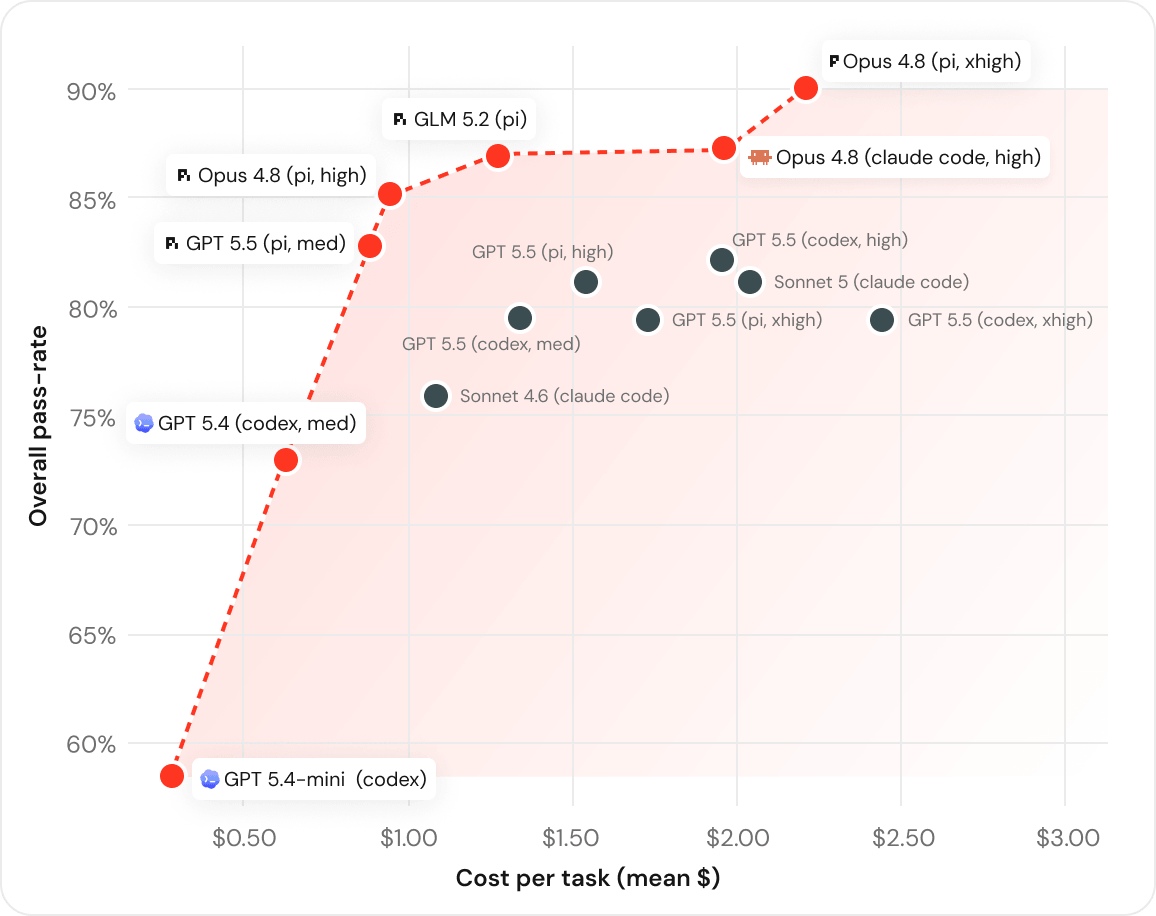
Databricks has published the results of an internal benchmark evaluating coding agents on its massive multi-million line codebase. The company conducted this extensive testing to determine how these tools can best optimize engineering costs and improve overall development performance.
Comments