Linux exempted from age law, IBM launches quantum foundry
Magnifica Humanitas
Pope Leo XIV has released an encyclical letter titled Magnifica Humanitas to address the ethical challenges posed by emerging technologies. The document outlines the moral imperative of safeguarding human dignity and protecting the human person in the rapidly expanding era of artificial intelligence.
CommentsCalifornia moves to exempt Linux from its age-verification law after backlash

California is amending its controversial age-verification law to exempt Linux operating systems following widespread backlash from the tech community. Despite this concession, Linux-based gaming platforms like SteamOS might still fall under the legislation's requirements and face ongoing compliance challenges.
CommentsExit IP VPN servers mitigation rollout

A new mitigation has been deployed to exit IP VPN servers to address recent network vulnerabilities. This rollout ensures enhanced security and stability for the affected infrastructure. A complete list of the specific servers that have received this update is now available for review.
CommentsFerrari Luce

The Ferrari Luce features a radically new architecture powered by an electric source and an advanced drivetrain. This innovative design uniquely combines extraordinary Ferrari performance with the luxury of a spacious interior.
CommentsToshifumi Suzuki, founder of Seven-Eleven Japan, has died
Toshifumi Suzuki, the founder of Seven-Eleven Japan who built the company into a global convenience store powerhouse, has died. Born in 1932, he revolutionized the retail sector by pioneering data-driven supply chains and advanced point-of-sale technologies. His passing marks the loss of a visionary business leader whose technological innovations continue to shape modern commerce.
CommentsA fundamental principle of aeronautical engineering has been overturned

A fundamental principle of aeronautical engineering has been overturned, challenging the long-held belief that smoother surfaces always reduce aerodynamic drag. Evidence now shows that this assumption is not universally true, which could significantly impact future aircraft design and performance modeling.
CommentsDidgeridoo playing as alternative treatment for obstructive sleep apnoea (2006)
A 2006 medical study investigated whether playing the didgeridoo could serve as an unconventional alternative treatment for moderate obstructive sleep apnoea. The research aimed to determine if the specific breathing techniques required for the instrument reduce upper airway collapsibility. Scientists evaluated if this non-invasive approach could successfully decrease daytime sleepiness and improve overall sleep quality for affected patients.
CommentsA successful Japanese trial of a ramjet engine designed for Mach‑5 aircraft

Japanese engineers have successfully completed a ground combustion trial of a ramjet engine designed for hypersonic aircraft. This successful test marks a major milestone in the development of next-generation vehicles capable of reaching speeds up to Mach-5.
CommentsNorway's 2 petabytes of Huawei flash storage and LLM training

Norway's National Library leverages 2 petabytes of Huawei flash storage to maintain a vast digital archive of Norwegian texts, though users remain frustrated by strict geo-restrictions and manual approval processes for accessing copyrighted materials. This massive dataset has sparked discussions about developing a sovereign Norwegian large language model to better preserve local history and culture. However, some skeptics argue that existing global models already train on sufficient multilingual data, potentially making a dedicated sovereign LLM unnecessary.
CommentsGnutella: A Protocol Outliving the World That Created It
A recent article explores the surprising longevity of the Gnutella peer-to-peer protocol, which continues to operate decades after its launch. The piece provides a technical explanation of how the decentralized network functions in the modern internet landscape. It ultimately highlights how this pioneering technology has managed to outlive the original era of file sharing that created it.
CommentsC extensions, portability, and alternative compilers
Discussions around C portability and alternative compilers reveal significant challenges in parsing non-standard, platform-specific code within header files. Developers continue to debate the trade-offs between strict POSIX compliance and leveraging OS-specific features like systemd, which frequently breaks compatibility for Windows and FreeBSD users. Ultimately, the discourse highlights that achieving true cross-platform compatibility in C remains difficult due to prevalent Linux-centric assumptions and inconsistent compiler support.
CommentsWhite Rabbit – sub-nanosecond synchronization for large distributed systems

White Rabbit is an advanced network synchronization technology that achieves sub-nanosecond timing for large distributed systems by syncing physical layers at Layer 1. By actively compensating for environmental delays, it can maintain picosecond-level clock accuracy across fiber optic distances up to 50 kilometers. This extreme precision is sufficient to measure relativistic effects, such as gravitational time dilation, across different altitudes.
CommentsBuild Adafruit projects right from Firefox

Firefox now supports the Web Serial API, allowing users to build and manage Adafruit hardware projects directly from their web browser. This integration enables developers to seamlessly connect, write code, and control compatible devices without relying on external native applications.
CommentsHacker News front page as a site

A new web tool transforms the standard Hacker News feed into a traditional newspaper-style front page. This redesign provides users with a unique, print-like reading experience for browsing the latest technology news and community discussions.
CommentsBug 1950764: Work Around Crash on Intel Raptor Lake CPU
Mozilla developers are implementing a workaround for a rare crashing bug on Intel Raptor Lake CPUs triggered by incorrect high-byte register storage at high boost clock speeds. This calculation error mirrors similar issues in other software and is widely suspected to be linked to Intel's ongoing silicon degradation and voltage instability problems. Due to the unpredictable nature of these crashes, Firefox has halted automated crash reporting for affected Raptor Lake processors.
CommentsShow HN: Write your BPF programs in Go, not C
A new open-source tool named gobee enables developers to write BPF programs in Go rather than C by transpiling a subset of Go code into BPF C. The project also automatically generates typed cilium/ebpf bindings to streamline the development process for the Go community.
CommentsNobody cracks open a programming book anymore
Traditional programming books are rapidly losing relevance as developers increasingly rely on digital documentation and online tutorials. This decline marks a melancholic shift in tech education, signaling the end of an era where programmers regularly cracked open physical coding manuals. Ultimately, the industry is moving away from static printed literature in favor of faster, dynamically updated online resources.
CommentsJira Is Turing-Complete
Reacting to an article about Jira's Turing-completeness, readers criticize the project management tool for its notorious complexity, sluggish interface, and alienating bureaucratic rules. Many express frustration that rival platforms like GitHub Issues are increasingly mimicking this feature bloat to secure corporate buy-in, despite heavy developer pushback. Ultimately, critics argue that Jira's underlying architecture is a poorly engineered accumulation of design cruft rather than a cohesive, well-architected system.
CommentsIBM Spins Off the First Pure-Play Quantum Chip Foundry

IBM is utilizing a $2 billion CHIPS Act investment across nine companies to launch Anderon, America's first pure-play quantum chip foundry. This strategic spin-off aims to significantly advance domestic manufacturing and innovation in the quantum computing sector.
CommentsScientists solve 200-year-old puzzle of how tobacco plants make nicotine

Researchers have finally solved a 200-year-old biological mystery by uncovering the exact natural processes tobacco plants use to produce nicotine. This breakthrough provides a comprehensive look at the complex biochemical pathways involved in plant alkaloid synthesis. Understanding these mechanisms could pave the way for future advancements in agricultural science and plant biotechnology.
CommentsJensen–Shannon Divergence
Recent reader discussions highlight Jensen-Shannon Divergence as a valuable mathematical tool that offers a symmetric distance metric compared to traditional Kullback-Leibler divergence. In machine learning, it is praised for balancing diversity and fidelity in generative AI models and for effectively detecting dataset drift. Commenters also emphasized its versatile applications beyond AI, including dimensionality reduction, data clustering, and physics research.
CommentsSearch engines alternatives now that Google isn't Google anymore

Google is implementing a major redesign that heavily integrates the AI overview feature into its search interface. Users dissatisfied with this new AI-first direction are increasingly exploring alternative search engines.
CommentsNetherlands Seizes 800 Servers, Arrests 2 for Aiding Cyberattacks

Dutch authorities arrested the co-owners of two internet hosting companies and seized 800 servers that Russia used to launch cyberattacks and disinformation campaigns. The seized IT infrastructure was specifically targeted for facilitating malicious influence operations across the European Union.
CommentsBytecode VMs in surprising places (2024)
A recent discussion highlights how bytecode virtual machines are implemented in unexpected environments, ranging from GPU kernels and PDF exploits to hardware firmware like EFI and ACPI. By utilizing a virtual machine approach in GPU shaders, developers can effectively bypass execution divergence and memory stalls in applications like the Dolphin emulator, Blender, and modern machine learning frameworks. Other surprising use cases for these virtual machines include Bitcoin transactions, TrueType fonts, and even running the Linux operating system directly within a graphics shader.
CommentsBuilding Pi with Pi
The Building Pi with Pi project explores the evolving landscape of open-source development in the post-AI era. It shares the team's key learnings and outlines their current strategy for integrating artificial intelligence into their collaborative workflows.
CommentsShow HN: OpenBrief – Local-first video downloader/summarizer
OpenBrief is a new open-source tool introduced on Hacker News that provides local-first video downloading and summarization capabilities. Developers can explore the code and contribute to the tantara/openbrief repository on GitHub.
CommentsThe Eternal Sloptember
The article argues that adopting AI agents in software development will be a costly mistake because they are merely statistical models mimicking code rather than actual programmers. Consequently, the output they produce is fundamentally flawed, and these underlying errors are becoming increasingly difficult to detect as the models improve.
CommentsShow HN: Geomatic – A command-driven geometry studio enabled with autodiff
Geomatic is a newly launched command-driven geometry studio featuring a geometric editor equipped with slash command autocomplete. Powered by automatic differentiation, the tool enables users to efficiently create and manipulate complex geometric designs.
CommentsMicrosoft Copilot Cowork Exfiltrates Files
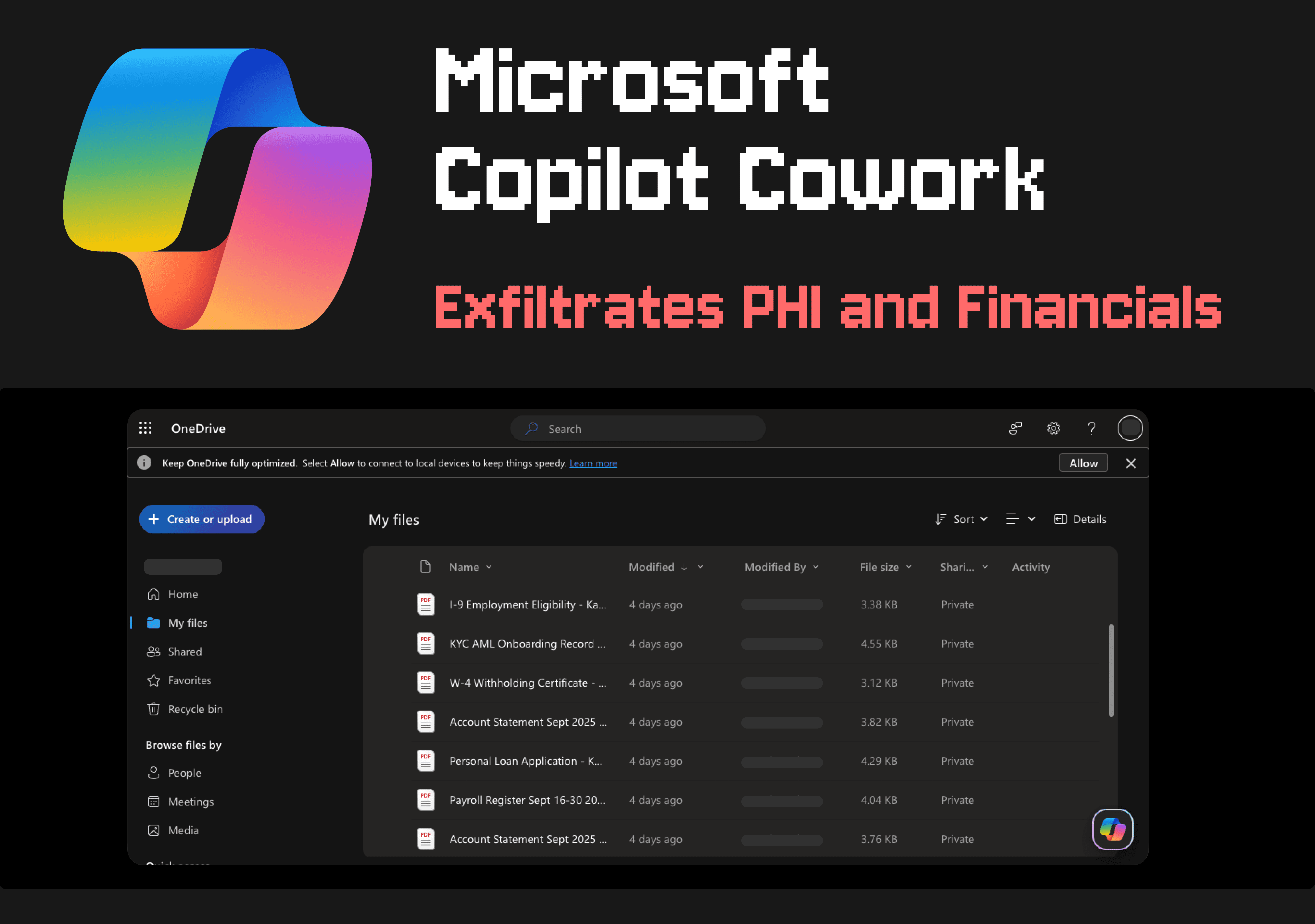
Microsoft Copilot Cowork is vulnerable to file exfiltration attacks via indirect prompt injection. The security flaw stems from the system's insecure automatic approvals for sending emails and Teams messages, which attackers can exploit to steal data.
CommentsAI errno(2) values
A recent piece proposes updating classic Unix errno system error codes to address the unique challenges of the artificial intelligence era, such as model hallucinations and context limit overflows. This concept highlights the evolving intersection of low-level systems programming and modern AI development by demonstrating the need to rethink foundational error-handling standards for machine learning.
Comments