Claude AI updates, privacy bills, and developer tools
Claude Design
Anthropic has launched Claude Design, a new Anthropic Labs product that enables users to collaborate with the AI to create polished visual assets. The tool allows for the quick generation of various professional materials, including designs, prototypes, presentation slides, and one-pagers.
CommentsMeasuring Claude 4.7's tokenizer costs
Independent testing of Claude 4.7 reveals its new tokenizer consumes more tokens than officially documented on real-world content. The measured 1.47x increase in token usage exceeds the documentation's projected range of 1.0 to 1.35x. This discrepancy indicates developers may face higher-than-expected tokenization costs.
CommentsBan the sale of precise geolocation

The latest edition of the Seriously Risky Business cybersecurity newsletter, now published on Lawfare, advocates for a strict ban on the commercial sale of precise geolocation data. The piece highlights the significant privacy and national security threats posed when data brokers sell highly accurate location tracking information to potentially malicious actors.
CommentsIsaac Asimov: The Last Question (1956)
Prompted by the thematic similarities to Isaac Asimov's The Last Question, readers are discussing the narrative-driven video game Outer Wilds and its 22-minute time-loop mechanic. A major debate has emerged over whether to spoil the game's inevitable death and reset cycle to prevent new players from quitting in frustration. While some advocate for revealing this core mechanic as a necessary compromise, purists argue that discovering the time loop organically is essential to the intended puzzle game experience.
CommentsShow HN: Smol machines – subsecond coldstart, portable virtual machines
A newly announced project called Smol Machines has introduced a lightweight, self-contained virtual machine that boasts ultra-fast subsecond coldstart times. This highly portable tool provides developers with an efficient solution for rapidly spinning up isolated computing environments.
CommentsMiddle schooler finds coin from Troy in Berlin
A middle school student in Berlin recently discovered an ancient coin originating from the historical city of Troy. The news sparked online discussions among readers about the serendipitous discovery of rare coins and unusual currency in everyday settings. Fans also shared humorous anecdotes about Apple co-founder Steve Wozniak's eccentric habit of spending uncut two-dollar bills like perforated coupons in retail stores.
CommentsNASA Force

NASA has officially launched a new specialized task force dedicated to advancing its core technological capabilities and future aerospace missions. This strategic initiative aims to streamline innovation across the agency by integrating next-generation computing and engineering solutions. The newly established group will also focus on expanding partnerships with private sector technology firms to accelerate deep space exploration.
CommentsI’m spending months coding the old way

Despite the widespread integration of artificial intelligence in software development, one developer is deliberately spending the next three months coding without any AI assistance. This self-imposed return to traditional programming aims to reinforce fundamental skills and establish a baseline for evaluating the true impact of AI tools on the industry.
CommentsShow HN: PanicLock – Close your MacBook lid disable TouchID –> password unlock
A new macOS utility called PanicLock allows users to instantly disable Touch ID and require a password to unlock their Mac. The tool can be triggered via a single click, a keyboard shortcut, or by simply closing the laptop lid, providing a quick security measure for sensitive situations.
CommentsNIST gives up enriching most CVEs

The US National Institute of Standards and Technology announced a new policy this Wednesday regarding the US National Vulnerability Database. Under this change, the agency will no longer enrich most CVEs with extended analysis. This shift represents a major change in how critical cybersecurity data is processed and distributed across the tech industry.
CommentsPlaydate’s handheld changed how Duke University teaches game design

Duke University has integrated the unique, crank-operated Playdate handheld into its game design curriculum to foster innovative thinking among students. The unconventional yellow console challenges learners to move beyond traditional button-based controls and develop highly creative, hardware-specific gameplay experiences.
CommentsCadQuery is an open-source Python library for building 3D CAD models
CadQuery is an open-source Python library that allows developers to build parametric 3D CAD models entirely through code. This scripting approach replaces traditional graphical interfaces to enable highly automated, customizable, and version-controlled design workflows.
CommentsA simplified model of Fil-C
A recent community discussion highlights Fil-C as an underrated project that brings memory safety to C without requiring a rewrite in Rust. However, critics emphasize that the project currently suffers from data race vulnerabilities due to non-atomic pointer updates and incurs noticeable performance overheads compared to compile-time safe alternatives. Despite these limitations, developers continue to experiment with the language, recently introducing a Bazel template to facilitate hermetic builds and invisible capability system variations.
CommentsShow HN: Stage – Putting humans back in control of code review

Stage is a new AI tool that streamlines the code review process by organizing pull requests into logical chapters. This structured approach allows human reviewers to comprehend code changes much faster, ultimately putting developers back in control of their workflows.
CommentsReflections on 30 years of HPC programming
A summary of Brad's HIPS 2025 keynote reflects on the evolution of High-Performance Computing programming over the past three decades. The discussion highlights both the significant technological advancements and the enduring paradigms that have shaped the field since the early 1990s.
CommentsUS Bill Mandates On-Device Age Verification

A newly proposed US bill contains a hidden mandate requiring on-device age verification for consumer electronics. This sweeping provision would apply to every laptop, gaming console, smart TV, and car infotainment system in the country.
CommentsAda, its design, and the language that built the languages
A recent analysis highlights how the Ada programming language successfully solved fundamental design challenges back in 1983. Its forward-thinking architecture addressed core software engineering needs long before they became industry standards. Today, modern systems languages like Rust, Go, and C++ are still independently converging on the pioneering solutions Ada established over four decades ago.
CommentsShow HN: SPICE simulation → oscilloscope → verification with Claude Code
A new demonstration highlights an integrated workflow combining SPICE circuit simulation, LeCroy oscilloscope control, and Claude Code for automated hardware verification. This toolchain allows developers to simulate electronic designs and leverage AI to verify the results directly against physical oscilloscope measurements.
CommentsA Python Interpreter Written in Python
A new project called Byterun implements a Python interpreter written entirely in Python, sparking community debate over the architectural differences between self-hosting interpreters and compilers. While critics note that circular interpreters can create inefficient runtime chains compared to self-hosted compilers, supporters highlight the project's value for educational experimentation and demystifying language execution. The ensuing discussion also delves into the technical nuances of bootstrapping and the exact definitions of interpreters, JIT compilers, and PyPy's compiled RPython subset.
CommentsIntroducing: ShaderPad
Programmer and designer Riley J. Shaw has introduced ShaderPad, a new project reflecting his commitment to repair and craft in technology. This release aligns with his broader mission to build transparent, remixable tools that promote a sustainable and accessible future.
CommentsHealthchecks.io now uses self-hosted object storage
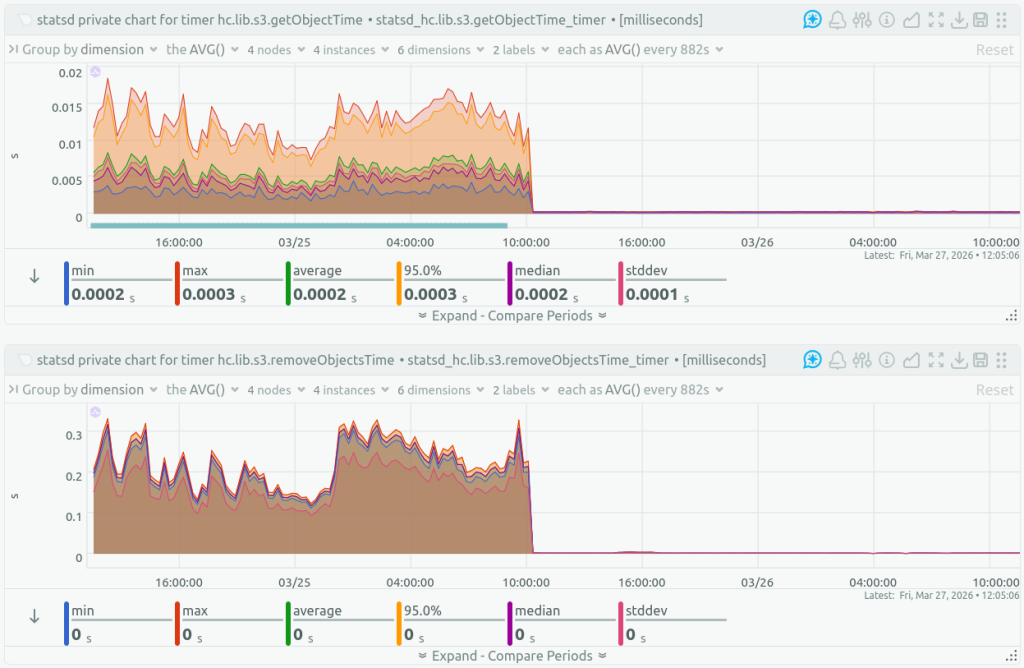
Healthchecks.io has migrated to a self-hosted, S3-compatible object storage system to manage larger request payloads from its monitoring endpoints. The service now routes HTTP POST bodies up to 100kB to this new infrastructure, while continuing to store smaller payloads directly in its PostgreSQL database.
CommentsFIM – Linux framebuffer image viewer
FIM is a Linux framebuffer image viewer that enables users to display images and perform file recovery directly from the terminal without a graphical desktop. Community discussions highlight similar framebuffer tools for media playback, though users note that modern lightweight Wayland setups often provide better hardware performance than traditional framebuffer devices. Despite these performance trade-offs, developers continue to embrace these minimalist environments for their extreme system simplicity and potential security benefits in an AI-driven landscape.
CommentsReBot-DevArm: open-source Robotic Arm
Seeed-Projects has launched ReBot-DevArm, an open-source robotic arm designed specifically for developers. The project is hosted on GitHub, where the community is invited to contribute to its ongoing development.
CommentsThe GNU libc atanh is correctly rounded
The GNU C Library has updated its math functions to achieve fully correct rounding for the double-precision atanh operation, moving beyond the traditional 1 ULP accuracy target. This ongoing initiative provides strict numerical guarantees that are essential for designing reliable algorithms in critical fields like aerospace and medical simulations. While these highly accurate implementations perform well on modern CPUs, developers still face significant optimization challenges when adapting them for GPU and NPU architectures.
CommentsExperiment with ICEYE Open Data
ICEYE has made a wealth of open data resources available for researchers and developers to experiment with. This initiative allows the tech community to freely explore and research the full potential of Synthetic Aperture Radar technology.
CommentsHuman Accelerated Region 1

Discussions surrounding Human Accelerated Region 1 highlight its critical activity in early brain development and spark broader scientific interest in mapping temporal gene activation patterns across the entire human life cycle. While researchers are developing advanced single-cell atlases to track these complex genetic expressions, creating a comprehensive visualization remains challenging due to ethical constraints and vast natural variability between individuals.
CommentsI built a 3D printing business and ran it for 8 months

A 3D printing enthusiast shares a firsthand business report detailing the practical realities of running their own 3D printing company for eight months. The account provides valuable insights for tech entrepreneurs regarding the operational challenges and financial viability of turning a hobby into a commercial enterprise.
CommentsEverything we like is a psyop?

This article examines the growing concern that TikTok's algorithmic feed is artificially shaping modern culture and consumer trends. It questions whether popular digital phenomena are the result of organic interest or manipulative growth hacking. Ultimately, the piece urges society to establish clear boundaries between legitimate marketing practices and inauthentic algorithmic manipulation.
CommentsConnie Converse was a folk-music genius. Then she vanished

Connie Converse was a pioneering folk musician who created forward-thinking songs in the 1950s. She remained largely unknown during her lifetime and mysteriously disappeared at the age of 50. Today, a new re-release of her recordings has finally earned her widespread recognition as a trailblazer.
CommentsDiscourse Is Not Going Closed Source

Following Cal.com's recent decision to close its source code over AI concerns, Discourse has announced it will remain open source. The platform's creators reaffirmed their commitment to transparent development after 13 years of building the software in public.
Comments